Water Solution – One Call Ahead
Enquire? Send Your Mail

What is a Sewage Treatment Plant (STP)?
A Sewage Treatment Plant (STP) is a facility that treats wastewater from residential, commercial, and industrial sources to remove contaminants, producing clean water that can be safely discharged or reused. STPs use a multi-stage process involving physical, chemical, and biological methods to purify water and manage byproducts like sludge, protecting public health and the environment by preventing water pollution.
Optima Water Solutions is a leading Sewage Treatment Plant manufacturer in Delhi NCR and across India, offering both customized and standardized STP systems designed to your site's flow, load, and space constraints. As a manufacturer — not a trading/reseller company — every STP is designed, fabricated, and supported end-to-end in-house.
Treated sewage is a resource that can be recycled for gardening, toilet flushing, car washing, and cooling towers — reducing freshwater consumption significantly.
Optima Water Solutions designs and manufactures several types of Sewage Treatment Plant to match different site conditions and budgets.
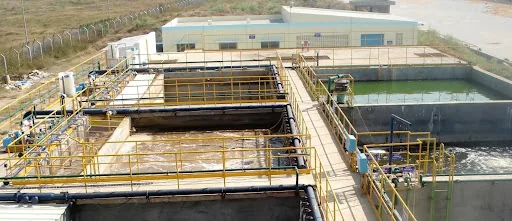
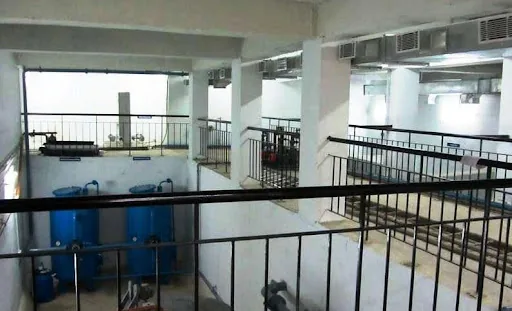
Civil Tank Based Sewage Treatment Plant (Conventional STP)
Optima Water Solutions designs and builds Civil-Based Sewage Treatment Plants (STP) — wastewater treatment systems constructed in RCC structures at the site. All the tanks and treatment units — Collection Tank, Equalization Tank, Aeration Tank, Clarifier, and Sludge Tank — are built permanently with civil construction. It is a permanent and durable infrastructure designed for long-term operation (20–25 years or more).
Recent Civil-Based STP projects designed and installed by Optima Water Solutions:
- 3000 KLD (3 MLD), 2400 KLD & 1600 KLD — GSRTC / Surat Railway Station, Gujarat
- 2200 KLD — Omaxe City, Lucknow, UP
- 1800 KLD & 1530 KLD — Dream Valley Amrapali Phase 2, Noida, UP
- 1200 KLD — Omaxe Panorama City, Bhiwadi
- 1530 KLD — HRRL Township, Pachpadra, Barmer, Rajasthan
- 1250 KLD — NTPC Township, Hissar, Haryana
Advantages of a Civil-Based STP
- RCC structures are strong, non-corrosive, and have a lifespan of 20–25 years or more.
- Suitable for permanent installations in housing societies, townships, hotels, hospitals, and industries.
- Civil construction allows customized layouts as per site conditions, flow, and load.
- Suitable for below-ground or partially underground installations.
- Tanks can be underground, saving space and improving site appearance.
- The top surface can be used for gardening, parking, or paving.
Prefabricated Sewage Treatment Plant
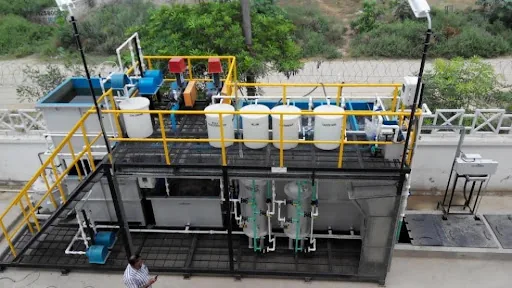
A Prefabricated Sewage Treatment Plant (STP) — also called a Packaged STP or Modular STP — is a factory-manufactured, ready-to-install wastewater treatment system, made from Mild Steel (MS), MSEP, MSFRP, or HDPE tanks. It comes in modular form, assembled and installed at site with minimal civil work.
It is designed for small to medium sewage loads (5 KLD to 200 KLD) and is ideal for residential, commercial, and institutional projects where quick installation and compact design are required.
Recent Prefabricated STP projects designed and installed by Optima Water Solutions:
- 250 KLD x 3 — Military Station, Port Blair, Andaman & Nicobar
- 100 KLD — Omaxe City, Sonipat
- 50 KLD — TS Tech, Neemrana, Rajasthan
- 20 KLD — Kerry Ingredients, Bawal
- 20 KLD — Makino Industries, Noida
Advantages of a Prefabricated STP
- Ready-to-install system; requires only basic foundation and piping.
- Installation time is much shorter (1–2 weeks) compared to 3–6 months for civil-based STP.
- Modular design takes up less space; ideal for small plots, basements, or retrofitted buildings.
- Prefabricated units can be shifted or relocated easily.
- Only a simple concrete base or support slab is needed.
- Saves construction cost, labor, and project time.
Containerized Sewage Treatment Plant (CSTP)
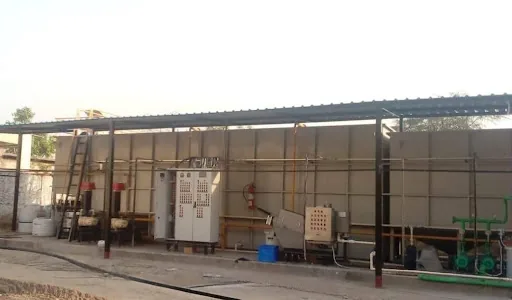
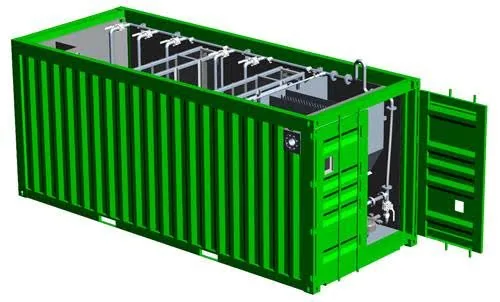
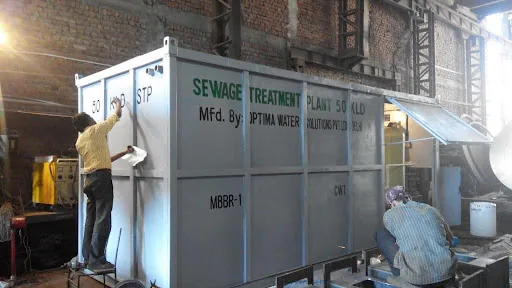
Optima Water Solutions designs and manufactures Containerized Sewage Treatment Plants (CSTP) — a fully assembled, plug-and-play wastewater treatment system built inside a standard shipping container (typically 20 ft or 40 ft). These plants treat domestic or industrial sewage efficiently without requiring large civil construction work.
They are prefabricated, modular, and portable, making them ideal for temporary sites, remote areas, or locations where quick installation and mobility are important.
Advantages of a Containerized STP
- Compact and self-contained unit
- Easy transportation and installation
- Fabricated from corrosion-resistant materials
- Equipped with all treatment units — collection, aeration, clarification, filtration, and disinfection
- Can be customized as per capacity (from 10 KLD to 100 KLD or more)
Treatment Technologies Used in CSTP
Containerized STPs can be designed using various biological treatment technologies:
- MBBR (Moving Bed Biofilm Reactor)
- MBR (Membrane Bio-Reactor)
- SBR (Sequencing Batch Reactor)
Recent Containerized STP (CSTP) projects designed and installed by Optima Water Solutions:
- 100 KLD x 3 — Omaxe City, Sonipat
- 50 KLD — Omaxe City, Indore
- 50 KLD — Omaxe Salamatpur
- 50 KLD — REPL, Lucknow
Reed Bed / Root Zone Filtration Based STP
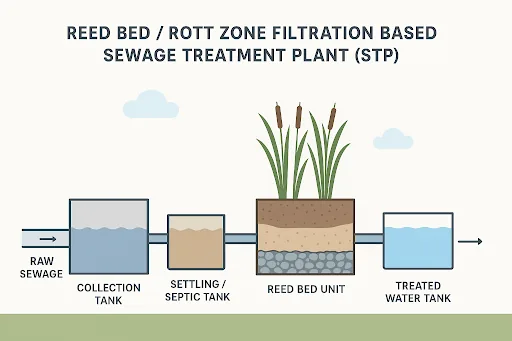
A Reed Bed Sewage Treatment Plant (STP), also known as a Root Zone Filtration System or Constructed Wetland System, is a natural, eco-friendly, and low-cost method for treating domestic or organic wastewater. It uses plants (like reeds, cattails, or canna) and gravel/sand beds to biologically treat sewage through natural filtration and microbial activity around plant roots.
The system mimics the natural purification process of wetlands. Wastewater passes through a series of layers — gravel, sand, and soil — planted with reeds or wetland plants. As water flows slowly through these layers:
- Microbes attached to the root surfaces degrade organic matter.
- Plant roots absorb nutrients like nitrogen and phosphorus.
- Soil and gravel filter out suspended solids.
The final water coming out is clear, odor-free, and suitable for gardening, landscaping, or flushing use.
Recent Reed Bed STP installations by Optima Water Solutions:
- 225 KLD — Omaxe, Rohtak
- 150 KLD — Omaxe EWS, Lucknow
- 180 KLD — Omaxe, Indore
- 20 KLD — Stone India Factory, Neemrana
Bio-Digester Sewage Treatment Plant
The Bio-Digester is a sustainable, eco-friendly sanitation system that uses anaerobic microbial bacteria to decompose human waste. This "flush and forget" technology converts waste into clean, usable water and harmless biogas (methane and carbon dioxide), with no need for a conventional sewage system.
How a Bio-Digester STP Works
- Specialized inoculum: The system is charged once with an Anaerobic Microbial Inoculum (AMI) developed by DRDO. The bacterial consortium can withstand extreme temperatures, from -20°C to +50°C, making it suitable for various climates.
- Anaerobic digestion: The biodigester tank — made of mild steel, fiber, or reinforced cement concrete (RCC) — uses an anaerobic process, meaning no oxygen is required. The AMI feeds on the fecal matter and multiplies on its own, continually breaking down the waste.
- Output: The biodegradation process results in three outputs — usable water, biogas, and no sludge (detailed below).
- Usable water: The effluent is odorless, colorless, and free of pathogens. It can be used for gardening, horticulture, or recycled for flushing, without polluting groundwater.
- Biogas: The remaining gas, a mixture of methane and carbon dioxide, is continuously released into the atmosphere or can be utilized for energy purposes.
- No sludge: The system achieves a waste reduction of up to 99%, and there is no accumulation of sludge, so the tank never needs to be emptied.
Advantages of a Bio-Digester STP
- Low maintenance: After the initial one-time charge of bacteria, the system is self-sustaining and requires very little maintenance.
- Environmentally friendly: It eliminates the contamination of soil and groundwater by converting waste into non-hazardous products.
- Space-saving: The units require significantly less space than conventional septic tanks, making them suitable for crowded areas.
- Customizable: The tanks can be custom-made to fit the needs of individual houses, apartment complexes, or other institutions.
- Cost-effective: Over the long term, minimal maintenance and resource recovery make it more economical than traditional waste disposal methods.
Why Choose Optima Water Solutions for Your STP
Optima Water Solutions is an ISO 9001:2015 certified manufacturer with 12+ years of experience and 158+ completed projects across India — including the civil, prefabricated, and containerized STP installations referenced above at GSRTC Surat, Omaxe City Lucknow, Dream Valley Amrapali Noida, and NTPC Hissar. We help you choose the right STP technology (civil, prefabricated, containerized, reed bed, or bio-digester) based on your actual site conditions, budget, and timeline — not a one-size-fits-all recommendation — and support every installation with commissioning, operator training, and AMC contracts.
Related reading: What is a Sewage Treatment Plant? Complete Guide · STP for Residential Societies in India · CPCB STP Norms 2026
STP Plant Manufacturer — Popular Locations
STP Manufacturer in Delhi · STP Manufacturer in Noida · STP Manufacturer in Gurugram · STP Manufacturer in Ghaziabad · STP Manufacturer in Faridabad · STP Manufacturer in Mumbai · STP Manufacturer in Jaipur · STP Manufacturer in Lucknow · STP Manufacturer in Pune · STP Manufacturer in Bengaluru · STP Manufacturer in Hyderabad · STP Manufacturer in Chennai
Get a Quote for Sewage Treatment Plant
Free site visit & custom proposal from our engineers within 48 hours. ISO 9001:2015 certified. 158+ projects delivered across India.
Common Questions
Sewage Treatment Plant — Frequently Asked Questions
What is a Sewage Treatment Plant (STP)?
A Sewage Treatment Plant (STP) is a facility that processes wastewater from residential, commercial, and industrial sources to remove contaminants and produce clean water that can be safely discharged or reused. STPs use multi-stage physical, chemical, and biological processes to purify water and manage byproducts like sludge.
What is the cost of an STP plant in Delhi NCR?
STP costs in Delhi NCR typically range from ₹5 Lakh for small packaged units (5–20 KLD) to ₹5 Crore or more for large civil-based systems (1 MLD+). The final price depends on capacity, technology (MBBR, MBR, SBR), site conditions, and automation level. Contact Optima Water for a free customized quotation.
What is the difference between Civil-Based and Prefabricated STP?
Civil-Based STPs are built in RCC structures on-site and are designed for permanent installations with a 20–25 year lifespan. Prefabricated (Packaged) STPs are factory-manufactured, ready-to-install systems that require minimal civil work and can be installed in 1–2 weeks.
Is it mandatory to have an STP in Delhi NCR?
Yes. As per DPCC and NGT guidelines, residential societies, commercial complexes, hotels, and industries generating wastewater above a prescribed limit are required to install and operate an STP. Non-compliance can result in heavy penalties.
What treatment technologies does Optima Water use for STP?
Optima Water designs STPs using MBBR (Moving Bed Biofilm Reactor), MBR (Membrane Bio-Reactor), SBR (Sequencing Batch Reactor), Conventional Activated Sludge Process, Reed Bed/Root Zone filtration, and Bio-Digester systems.
Can the treated water from an STP be reused?
Yes. Treated STP effluent can be reused for gardening, toilet flushing, car washing, cooling towers, and landscaping — significantly reducing freshwater consumption.
Ready to Start?
Free site visit and assessment by our engineers. 158+ projects delivered across India.