Water Solution – One Call Ahead
Enquire? Send Your Mail

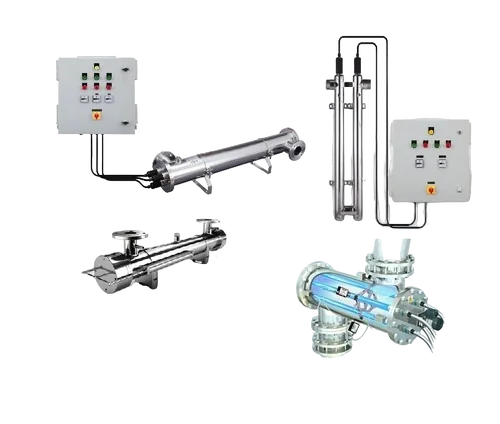
Ultraviolet (UV) Water Disinfection System
An Ultraviolet (UV) disinfection system uses short-wavelength UV-C light to destroy the DNA of bacteria, viruses, and protozoan cysts in water, preventing them from reproducing and rendering them harmless — without adding any chemicals to the water. It is one of the fastest and most widely used final-stage disinfection methods for drinking water, RO/UF permeate, swimming pools, and process water across India.
Optima Water Solutions designs and supplies UV disinfection systems engineered for municipal, industrial, commercial, and residential water treatment applications, achieving a 4-log reduction (99.99%) in bacteria, viruses, and protozoan cysts such as Giardia lamblia and Cryptosporidium.
How UV Disinfection Works
Water passes through a chamber containing one or more UV-C lamps housed in a quartz sleeve. As microorganisms pass through the UV light path, the radiation penetrates their cell walls and disrupts their DNA/RNA structure, preventing replication. Because it's a physical process rather than a chemical one, UV disinfection:
- Adds no chemicals, taste, odor, or color to the treated water
- Creates no harmful disinfection by-products (unlike chlorination)
- Leaves no toxic or corrosive chemicals to generate, handle, transport, or store
- Has no residual effect harmful to humans, animals, or aquatic life
- Works within seconds, with no contact-time tank required
Types of UV Disinfection Systems
Not all UV systems are built the same way, and choosing the wrong type is a common reason installations underperform:
- Low-Pressure (LP) UV systems — the most common type for residential and light commercial use. Operate at lower power, produce monochromatic UV-C at 254nm, and are energy-efficient for flows up to a few hundred LPH.
- Medium-Pressure (MP) UV systems — used for higher-flow municipal and industrial applications. Produce a broader UV spectrum and handle significantly higher flow rates per unit, at higher power draw.
- UV-LED systems — an emerging technology using solid-state LEDs instead of mercury lamps, offering instant on/off operation and longer component life, currently more common in compact/point-of-use applications.
Sizing a UV System Correctly
UV dose (measured in mJ/cm²) is a function of UV intensity, exposure time, and — critically — the water's UV Transmittance (UVT), which measures how much UV light actually penetrates the water rather than being absorbed by dissolved organics, iron, or turbidity. Two identical-looking UV systems can deliver very different real-world disinfection results if one is sized for 95% UVT water and installed on a 75% UVT source. This is why Optima always requests a water quality report before sizing — a UV system sized purely on flow rate (LPH) without checking UVT is the most common cause of under-dosed, non-compliant disinfection in the field.
UV vs Chlorination vs Ozone: Choosing the Right Disinfection Method
| UV Disinfection | Chlorination | Ozone | |
|---|---|---|---|
| Chemical residual | None | Yes (can taste/smell) | None (decays quickly) |
| Disinfection by-products | None | Trihalomethanes (THMs) possible | Bromate possible in bromide-rich water |
| Effective against Cryptosporidium | Yes, highly effective | Poor — chlorine-resistant | Yes |
| Speed | Seconds, no contact tank | Requires contact time (20-30 min) | Requires contact time |
| Capital + running cost | Low-moderate | Low | High |
| Residual protection downstream | None (point-of-use only) | Yes, protects distribution piping | Minimal |
In practice, many of our municipal and packaged drinking water clients use a combination — a small chlorine residual for distribution-line protection plus UV as the primary pathogen-kill step — rather than choosing one exclusively.
How UV Disinfection Works
Water passes through a chamber containing one or more UV-C lamps housed in a quartz sleeve. As microorganisms pass through the UV light path, the radiation penetrates their cell walls and disrupts their DNA/RNA structure, preventing replication. Because it's a physical process rather than a chemical one, UV disinfection:
- Adds no chemicals, taste, odor, or color to the treated water
- Creates no harmful disinfection by-products (unlike chlorination)
- Leaves no toxic or corrosive chemicals to generate, handle, transport, or store
- Has no residual effect harmful to humans, animals, or aquatic life
- Works within seconds, with no contact-time tank required
Where UV Systems Are Used
- Post-RO/UF polishing — final disinfection barrier after reverse osmosis or ultrafiltration
- Drinking water treatment — municipal supply, packaged drinking water plants, residential RO systems
- Swimming pools & spas — reduces chlorine dependency and chloramine formation
- Food & beverage processing — process water disinfection without chemical residue
- Pharmaceutical & healthcare — high-purity water systems, dialysis water
- Rainwater harvesting & borewell water — pathogen control for reuse applications
Maintenance Requirements
UV systems have low but non-negotiable maintenance needs. Quartz sleeves need periodic wiping/cleaning to prevent mineral scaling from blocking UV transmission, and lamps lose output over their service life (typically rated for 9,000-12,000 hours, roughly one year of continuous use) and need replacement on schedule — not just when they visibly fail, since UV output degrades well before the lamp goes fully dark. Skipping scheduled lamp replacement is the second most common cause of silent disinfection failure after incorrect sizing.
Why Choose Optima Water Solutions for UV Systems
Optima Water Solutions is an ISO 9001:2015 certified manufacturer with 12+ years of experience and 158+ completed water and wastewater treatment projects across India. Our UV systems are sized to the actual flow rate and UV transmittance (UVT) of your specific water source — not sold off a generic capacity chart — because undersized UV dosage is the single most common reason disinfection systems underperform in the field. We handle site assessment, system sizing, supply, installation, and ongoing lamp/sleeve replacement support (typically annual) so disinfection performance doesn't quietly degrade after the first year.
Get a Quote for Ultraviolet System
Free site visit & custom proposal from our engineers within 48 hours. ISO 9001:2015 certified. 158+ projects delivered across India.
Common Questions
Ultraviolet System — Frequently Asked Questions
How does UV water disinfection work?
UV disinfection exposes water to UV-C light (wavelength ~254 nm) inside a stainless steel chamber. UV-C radiation penetrates the cell walls of microorganisms and disrupts their DNA, preventing them from reproducing. This achieves a 4-log (99.99%) reduction in bacteria, viruses, and protozoan cysts without adding any chemicals.
What are the advantages of UV disinfection over chlorination?
UV disinfection has no chemical storage or handling requirements, produces no disinfection by-products (unlike chlorine which forms THMs and HAAs), does not alter taste, odor, or pH of water, provides instant disinfection, and is effective against chlorine-resistant pathogens like Cryptosporidium and Giardia.
What is a 4-log reduction in UV disinfection?
A 4-log reduction means a 99.99% reduction in the target microorganism population. For example, if 10,000 bacteria are present per mL of water, after 4-log UV treatment only 1 bacteria per mL would remain.
What pre-treatment is required before a UV system?
UV disinfection requires clear water with low turbidity (below 1 NTU), low color, and low suspended solids. Pre-treatment with a Pressure Sand Filter and/or UF membrane is typically required to ensure the UV light can penetrate the water effectively.
How long do UV lamps last?
Commercial UV lamps for water treatment typically have a rated life of 9,000–12,000 hours (approximately 12–18 months of continuous operation). Annual lamp replacement is recommended to maintain guaranteed disinfection performance.
Can UV disinfection be used for wastewater treatment?
Yes. UV disinfection is widely used as a final polishing step in STP and ETP effluent treatment to disinfect treated water before discharge or reuse. It is increasingly replacing chlorination for its environmental advantages.
Ready to Start?
Free site visit and assessment by our engineers. 158+ projects delivered across India.