Water Solution – One Call Ahead
Enquire? Send Your Mail

Where Nanofiltration Fits in the Membrane Filtration Spectrum
| Technology | Pore Size | Removes | Operating Pressure |
|---|---|---|---|
| Microfiltration (MF) | 0.1–10 microns | Suspended solids, bacteria | <2 bar |
| Ultrafiltration (UF) | 0.01–0.1 microns | Colloids, viruses, most bacteria | 1–5 bar |
| Nanofiltration (NF) | 0.001–0.01 microns | Divalent ions, organics, dyes, pesticides — partial monovalent salt passage | 4–30 bar |
| Reverse Osmosis (RO) | <0.001 microns | Nearly all dissolved salts, including monovalent ions | 8–80 bar |
The practical significance of NF sitting between UF and RO is that it removes hardness-causing divalent ions (calcium, magnesium) and larger organic molecules while allowing more monovalent ions (like sodium) to pass through than RO would — which is exactly why NF is described as "selective" filtration rather than the comprehensive desalination RO performs.
INTRODUCTION TO NANO FILTRATION PLANT
Nanofiltration is a pressure-driven process that bridges the gap between ultrafiltration and reverse osmosis (RO). It utilizes a semi-permeable membrane to selectively remove divalent ions (such as calcium and magnesium), organic compounds, and heavy metals while allowing specific beneficial minerals to pass through.
Unlike traditional osmosis, which naturally moves solvents toward higher concentrations, Nanofiltration applies external pressure to force water through the membrane from a high-concentration region to a low-concentration one. This allows for "selective filtration"—removing harmful contaminants like pesticides and viruses while maintaining a healthier mineral balance for drinking water and specialized industrial uses.
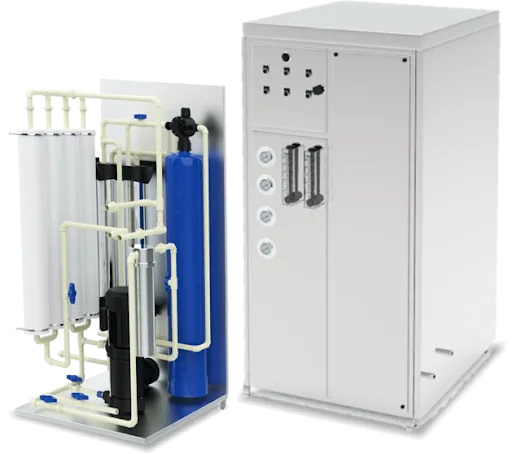
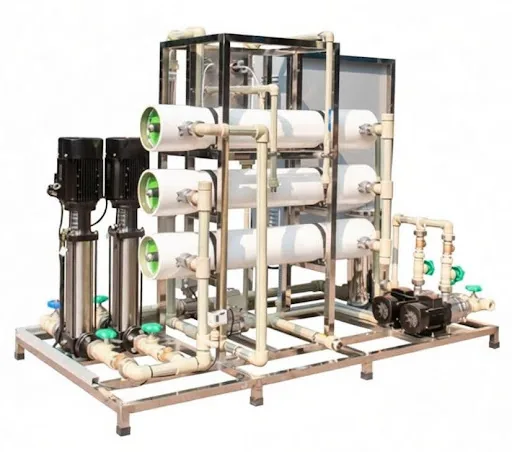
Nanofiltration has increasingly replaced traditional RO in applications where deep desalination is not required but high-efficiency softening and organic removal are critical. We are a Authorised dealer of Purever Nano Filtration Plant.
Features of Our Nanofiltration Plants
- Smart Automation: Fully automatic systems with IoT-enabled remote monitoring for real-time performance tracking.
- Maximized Water Recovery: Advanced membranes achieving up to 75–85% recovery rates, significantly reducing wastewater compared to standard systems.
- Durability & Hygiene: Systems built with high-grade Stainless Steel (SS) or corrosion-resistant FRP for long-term industrial reliability.
- Energy Efficiency: Lower operating pressures (typically 4–30 bar) and the integration of Energy Recovery Devices (ERDs) help lower electricity costs compared to RO.
- Mineral Retention: Selective removal of hardness (calcium/magnesium) while retaining essential monovalent ions, ensuring non-aggressive, healthy water.
How to Decide: Nanofiltration or Full RO?
This is the single most common technical question we field on this product line, so it's worth answering directly. Choose nanofiltration if your goal is softening plus organics/pesticide/color removal and some dissolved-solid reduction is acceptable — NF achieves this at meaningfully lower pressure and energy cost than RO, with higher water recovery. Choose full RO if your application requires near-complete desalination (drinking water with strict TDS targets, boiler feed, or any process requiring very low conductivity output) — NF simply won't get you there since it's designed to be selective, not comprehensive. Sizing this correctly at the proposal stage avoids the two most common expensive mistakes: over-specifying RO (and paying for energy/membrane capacity you don't need) or under-specifying NF for an application that actually needed full desalination.
Where Nanofiltration Plants Are Used
- Drinking water treatment — softening plus organic/pesticide removal without full desalination
- Dairy & food processing — selective concentration of process streams
- Textile industry — dye and color removal from process water
- Pharmaceutical manufacturing — selective separation of organic compounds
- Water softening at scale — an energy-efficient alternative to ion-exchange softening for larger flows
Why Choose Optima Water Solutions for Nanofiltration
Optima Water Solutions is an ISO 9001:2015 certified manufacturer with 12+ years of experience and 158+ completed projects across India, and an authorised dealer of Purever Nano Filtration Plants. We help you determine whether nanofiltration or full RO is the right fit for your water quality goals — over-specifying RO when NF would suffice wastes energy and water recovery unnecessarily.
Get a Quote for Nano Filtration Plant
Free site visit & custom proposal from our engineers within 48 hours. ISO 9001:2015 certified. 158+ projects delivered across India.
Common Questions
Nano Filtration Plant — Frequently Asked Questions
What is Nano Filtration and how is it different from RO?
Nanofiltration (NF) is a pressure-driven membrane process that bridges the gap between ultrafiltration and reverse osmosis. Unlike RO which rejects nearly all dissolved salts, NF selectively removes divalent ions (calcium, magnesium, sulfates) and organic compounds while allowing beneficial monovalent minerals to pass through.
What are the main applications of Nano Filtration Plants?
Nano Filtration is used for water softening, removal of pesticides and organic micropollutants from drinking water, color removal in textile effluent treatment, dairy industry water treatment, and as a pre-treatment before RO to extend membrane life.
What is the water recovery rate of a Nano Filtration Plant?
Nano Filtration Plants achieve 75–85% water recovery, which is higher than typical RO systems. The lower operating pressure (4–30 bar) combined with high recovery makes NF significantly more energy-efficient.
What is the cost of a Nano Filtration Plant in India?
Nano Filtration Plant costs range from ₹3 Lakh for small units to ₹2 Crore for large industrial systems. Optima Water is an authorised dealer of Purever Nano Filtration Plants in India.
What maintenance does a Nano Filtration Plant require?
Nano Filtration Plants require periodic CIP chemical cleaning (every 1–3 months), cartridge filter replacement, antiscalant dosing refill, and annual membrane performance testing.
Can Nano Filtration be used for drinking water treatment?
Yes. Nano Filtration removes pesticides, herbicides, hardness, and color while retaining essential beneficial minerals, producing healthier, better-tasting water compared to RO.
Ready to Start?
Free site visit and assessment by our engineers. 158+ projects delivered across India.