Water Solution – One Call Ahead
Enquire? Send Your Mail
EDI vs Mixed-Bed Deionization: Why EDI Has Become the Standard
| EDI | Mixed-Bed Ion Exchange | |
|---|---|---|
| Regeneration | Continuous, electrical — no downtime | Periodic, requires acid/caustic chemicals |
| Chemical handling | None required | Hazardous acid/caustic storage and handling |
| Operating consistency | Stable output resistivity throughout run | Resistivity drifts down as resin exhausts between regenerations |
| Waste stream | Small continuous reject stream, no neutralization needed | Periodic hazardous chemical waste requiring neutralization/disposal |
| Typical output | 5-18 MΩ·cm | Up to 18 MΩ·cm, but degrades between regenerations |
This is why EDI has largely replaced mixed-bed systems in new pharmaceutical, power, and electronics installations over the past decade — the elimination of on-site hazardous chemical handling alone is often reason enough, before even factoring in the operational consistency advantage.
Why EDI Needs RO Pretreatment
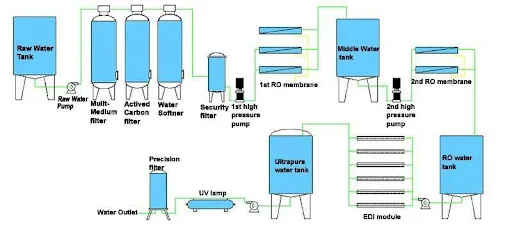
EDI is not a standalone technology — it requires RO-permeate-quality water as its feed to work correctly. EDI membranes and resin are engineered for low-TDS water (ideally under 25 ppm, achieved by RO); feeding EDI with raw or lightly treated water causes rapid membrane fouling and scaling, and voids most manufacturer warranties. This is why EDI is always specified as the polishing stage after RO, never as a replacement for it — a distinction we're careful to explain to clients evaluating deionization technology for the first time.
EDI (Electrodeionization) Systems by Optima Water
Ultrapure Water. Zero Chemicals. Continuous Performance.
As a leading EDI System Manufacturer in India, Optima Water provides the ultimate solution for industries requiring high-purity water. Electrodeionization (EDI) is a revolutionary process that combines ion-exchange membranes and electricity to produce ultrapure water without the need for hazardous regeneration chemicals.
EDI is recognized as the most sustainable and cost-effective alternative to traditional Mixed-Bed (MB) ion exchangers.
- Chemical-Free Operation: EDI is a physical process rather than a chemical one. This eliminates the need to generate, handle, transport, or store toxic/hazardous acids and caustic chemicals for resin regeneration.
- Continuous Regeneration: The electrical field continuously regenerates the resin beads within the module. This means zero downtime for regeneration and a constant flow of ultrapure water.
- Environmental Sustainability: Because no regenerative chemicals are used, there are no harmful chemical neutralized waste streams to manage. It is the most ecological way to achieve high resistivity.
Safety First: There is no hazardous residual effect, making it completely safe for high-stakes environments like pharmaceutical labs and power plants.
How EDI Works
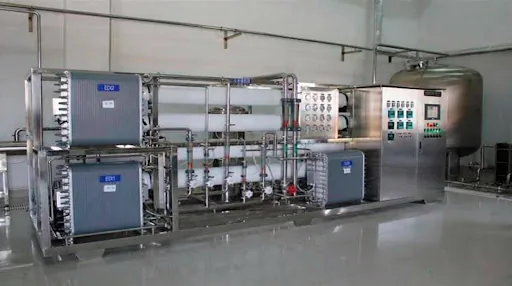
EDI modules combine ion-exchange resin, semi-permeable membranes, and a DC electrical field. Water passes through resin-filled compartments where ions are removed and transported across the membranes under the electrical field into a concentrate stream — continuously regenerating the resin without any chemical addition. The result is consistently high-purity water (typically 5–18 MΩ·cm resistivity) suitable for the most demanding applications.
Where EDI Systems Are Used
- Pharmaceutical manufacturing — Purified Water (PW) and Water for Injection (WFI) pretreatment
- Power plants — boiler feed water requiring very low conductivity
- Electronics & semiconductor manufacturing — ultrapure process water
- Laboratories & research facilities — high-resistivity water for analytical work
- Food & beverage — process water polishing after RO
Why Choose Optima Water Solutions for EDI
Optima Water Solutions is an ISO 9001:2015 certified manufacturer with 12+ years of experience and 158+ completed projects across India. We design EDI systems as part of a complete pretreatment train — RO followed by EDI — sized correctly for your feed water quality and target resistivity, rather than selling an oversized or undersized module in isolation. Our support includes commissioning, resin/membrane performance monitoring, and AMC contracts to keep resistivity consistent over the system's operating life.
Get a Quote for EDI Electrodeionization System
Free site visit & custom proposal from our engineers within 48 hours. ISO 9001:2015 certified. 158+ projects delivered across India.
Common Questions
EDI Electrodeionization System — Frequently Asked Questions
What is EDI (Electrodeionization)?
Electrodeionization (EDI) is a water purification process that combines ion-exchange membranes, ion-exchange resins, and a DC electric current to continuously produce ultrapure water without hazardous chemical regenerants. EDI typically follows a Reverse Osmosis system and produces water with resistivity up to 18 MΩ·cm.
What is the difference between EDI and a Mixed Bed (MB) Ion Exchanger?
A Mixed Bed (MB) Ion Exchanger requires periodic regeneration using hazardous acids (HCl) and caustics (NaOH), resulting in chemical storage, handling risks, and downtime. EDI uses electricity for continuous regeneration — eliminating all chemical use, producing zero regeneration waste, and operating 24/7 without interruption.
Which industries use EDI systems?
EDI systems are used in pharmaceutical manufacturing, power plants (boiler feed water), semiconductor and electronics manufacturing, laboratories, food and beverage processing, and any application requiring consistently high-purity water above 1 MΩ·cm resistivity.
What feed water quality does EDI require?
EDI requires pre-treated RO permeate as feed water. Typical feed requirements: TDS below 50 mg/L, hardness below 1 mg/L as CaCO₃, free chlorine below 0.05 mg/L, CO₂ below 5 mg/L, and temperature between 5°C–35°C.
What is the cost of an EDI system in India?
EDI system costs in India range from ₹5 Lakh for small laboratory/pharmaceutical units to ₹3 Crore or more for large power plant or semiconductor fab installations.
Does EDI require any maintenance?
EDI modules have no moving parts and require minimal maintenance. Periodic tasks include monitoring feed water quality, checking electrode voltage and current, CIP cleaning if organic fouling occurs, and annual module performance testing.
Ready to Start?
Free site visit and assessment by our engineers. 158+ projects delivered across India.