Water Solution – One Call Ahead
Enquire? Send Your Mail

Types of Water Softener Control Valves
- Manual/Timer-based softeners — regenerate on a fixed schedule regardless of actual usage; lowest cost, but wastes salt and water on low-usage days and can run out of capacity on high-usage days.
- Meter-based (demand-initiated) softeners — regenerate based on actual measured water usage rather than a fixed clock, matching regeneration frequency to real demand. This is what we recommend for most commercial and industrial installations since it materially reduces salt and water consumption versus timer-based control.
- Twin-tank (alternating) softeners — use two resin tanks so one is always in service while the other regenerates, ensuring continuous soft water supply with zero downtime during regeneration — standard for facilities that can't tolerate a hardness spike during the regeneration cycle.
Water Softener vs Reverse Osmosis for Hardness Removal
| Ion-Exchange Softener | Reverse Osmosis | |
|---|---|---|
| Removes hardness (Ca/Mg) | Yes — this is its specific function | Yes, but as a side effect of removing all dissolved solids |
| Removes other dissolved solids/salts | No | Yes, comprehensively |
| Running cost for hardness-only needs | Lower | Higher (energy + membrane + reject water) |
| Best for | Boiler feed, laundries — where only hardness is the problem | Drinking water or process water needing full TDS reduction |
Many of our industrial clients use both in sequence — a softener to protect the RO membranes from scaling, followed by RO for full TDS reduction — since softening ahead of RO significantly extends membrane life and reduces cleaning frequency.
Water Softening Plant
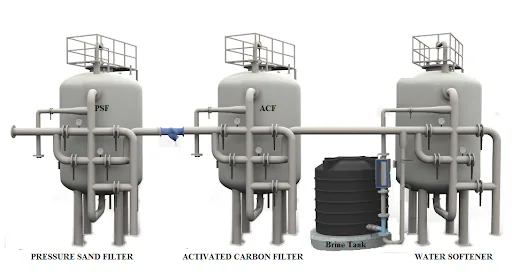
Softening is the process of removing Calcium and Magnesium ions from water through Cation exchange. This is typically used to reduce scaling tendency of water used for boiler feed, or to increase the lather effect of detergents, particularly in laundries & process, Calcium and Magnesium ions in solution are exchanged for sodium ions attached to a cationic resin. When water is passed through this resin, the calcium and magnesium ions in the water displace the Sodium Ions, and adsorb onto the resin. During the regeneration process, a highly concentrated saline solution (15-30% NaCl) is used to “wash” the resin. This causes the Ca or Mg which is adsorbed on the resin to be replaced with Na.
Sizing of Softener is based on three factors; the capacity of the softener (flow rate), feed water hardness, and frequency of regeneration required.
Scale buildup of just 1.6mm can reduce heat transfer efficiency by up to 12%, leading to massive energy waste. Optima Water’s softening solutions ensure:
- Extended Equipment Life: Prevent scaling in boilers, heat exchangers, and cooling systems.
- Reduced Chemical Costs: Lower the amount of detergents and chemicals needed for cleaning and processing.
- Energy Efficiency: Keep heating surfaces clean for maximum thermal conductivity.
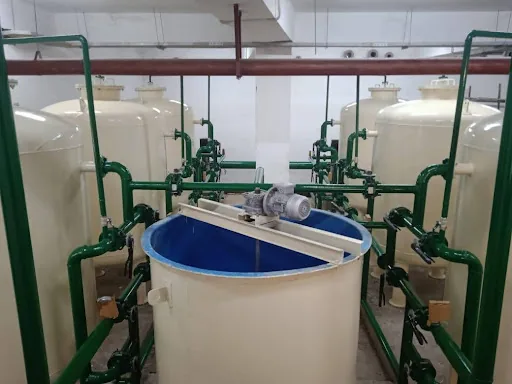
Precision Brine Systems: Optimized salt-to-water ratios in our brine tanks to ensure efficient regeneration with minimal salt wastage.
Water Hardness Levels in India
Hardness varies significantly by region — groundwater in Delhi NCR, Rajasthan, Gujarat, and much of the Indo-Gangetic plain commonly tests between 300-600+ mg/L as CaCO3 (classified as "very hard"), while some hill and coastal regions see naturally softer source water. Because the correct softener resin volume and regeneration frequency depend directly on your actual feed water hardness (not a regional assumption), we test or request a recent water analysis before finalizing system sizing rather than sizing off a generic regional average.
Where Water Softeners Are Used
- Boiler feed water — preventing scale that reduces heat transfer efficiency
- Laundries & hotels — improving detergent lather effect and fabric life
- RO pre-treatment — protecting RO membranes from hardness-related scaling
- Cooling towers & heat exchangers — maintaining thermal efficiency
- Residential apartments — softer water for daily use across hard-water regions like Delhi NCR, Rajasthan, and Gujarat
Why Choose Optima Water Solutions for Water Softening
Optima Water Solutions is an ISO 9001:2015 certified manufacturer with 12+ years of experience and 158+ completed projects across India. We size every softener based on your actual flow rate, feed water hardness, and required regeneration frequency — not a generic capacity table — because incorrect sizing is the most common reason softeners run out of capacity mid-cycle or waste salt on over-regeneration.
Get a Quote for Water Softener Plant
Free site visit & custom proposal from our engineers within 48 hours. ISO 9001:2015 certified. 158+ projects delivered across India.
Common Questions
Water Softener Plant — Frequently Asked Questions
What is a Water Softener Plant and how does it work?
A Water Softener Plant removes hardness-causing calcium and magnesium ions from water through cation exchange. Hard water passes through a bed of cation exchange resin where calcium and magnesium ions are replaced with sodium ions. The resin is periodically regenerated using a concentrated salt (NaCl) solution.
Why is hard water a problem for industries?
Hard water causes scale buildup in boilers, heat exchangers, pipes, and cooling towers. Scale buildup of just 1.6mm can reduce heat transfer efficiency by up to 12%, significantly increasing energy consumption and causing premature equipment failure.
What is the difference between a Water Softener and an RO system?
A Water Softener selectively removes calcium and magnesium (hardness) while retaining all other dissolved solids. RO removes all dissolved solids. For applications where only hardness removal is needed (boiler feed, laundries, cooling), a softener is the most cost-effective choice.
How often does a Water Softener need to be regenerated?
Regeneration frequency depends on feed water hardness and the softener capacity (resin volume). Typical small softeners in Delhi NCR may need regeneration every 24–72 hours. Modern automatic softeners regenerate on demand based on volume processed.
Can a Water Softener be used for drinking water?
Domestic water softeners can make water softer for household use, but the elevated sodium content may not be ideal for drinking, particularly for people on low-sodium diets. A dedicated RO point-of-use system is recommended for drinking water.
What salt consumption should I expect from a Water Softener?
Salt consumption depends on system capacity, feed water hardness, and regeneration efficiency. Optima Water Precision Brine Systems optimize salt-to-water ratios to ensure efficient regeneration with minimal salt wastage.
Ready to Start?
Free site visit and assessment by our engineers. 158+ projects delivered across India.