Water Solution – One Call Ahead
Enquire? Send Your Mail

Building a Complete Water Treatment Train, Stage by Stage
| Stage | Removes | When It's Needed |
|---|---|---|
| Media/Sand Filtration (PSF) | Suspended solids, turbidity down to ~30 microns | Almost always — the first line of defense for any raw water source |
| Activated Carbon (ACF) | Chlorine, organics, odor, color | Where source water has chlorine, organic contamination, or taste/odor issues |
| Softening | Calcium, magnesium hardness | Hard water regions — protects downstream RO/boiler equipment |
| Ultrafiltration (UF) | Bacteria, viruses, colloids down to 0.015 micron | Where pathogen removal or RO pre-treatment is needed |
| Demineralization / RO | Dissolved ionic and metallic impurities, salts | Where low-TDS or boiler-feed-quality water is the target |
Very few sites need every stage — the point of a proper water treatment design is identifying which stages your specific source water actually requires, based on a real water quality test, rather than defaulting to a maximal (and unnecessarily expensive) treatment train.
Why Source Water Testing Comes Before Design
The correct water treatment plant configuration depends entirely on what's actually in your source water — borewell water in one part of Delhi NCR can have completely different iron, hardness, and turbidity characteristics than borewell water a few kilometers away. We test (or request a recent lab report for) turbidity, hardness, iron/manganese content, TDS, and pH before finalizing a treatment train design, because designing off assumptions rather than actual data is the most common reason a "water treatment plant" underperforms — not because the equipment was faulty, but because it was never treating the actual contaminants present.
WATER TREATMENT PLANT
High-quality Water Treatment Solutions are essential for ensuring safety and operational efficiency across industrial, commercial, and residential sectors. Below is a comprehensive guide to various water treatment plants and systems.
We are a leading Water Treatment Plant Manufacturer in India. Water Treatment Plant is meant for removing the suspended impurities, metal and ionic impurities. The system is used for reclaiming the water from ground or surface. The aim of putting the water treatment plant can be simple filtration whereby all suspended impurities are removed. The suspended impurities are removed by simple media filtration where particle size of up-to 30 micron is aimed. The smaller particle which causes turbidity are removed by microfiltration and Ultra-filtration where the particles up to 0.015 micron can be removed. This also eliminates 99% bacteria and virus thus removing max pathogens.
Softening units are applied where hardness is required to be removed.
Demineralization unit are installed where removal of ionic impurities and metallic impurities are aimed to be achieved.
Membrane filtration which removes the ionic and metallic impurities varies from Nano to Bohr size. The application of Nano filtration is done where max number of monovalent ions are required to be rejected and Reverse Osmosis is applied with an aim to reject all salt/ion with max rejection.
MEDIA FILTRATION SYSTEMS
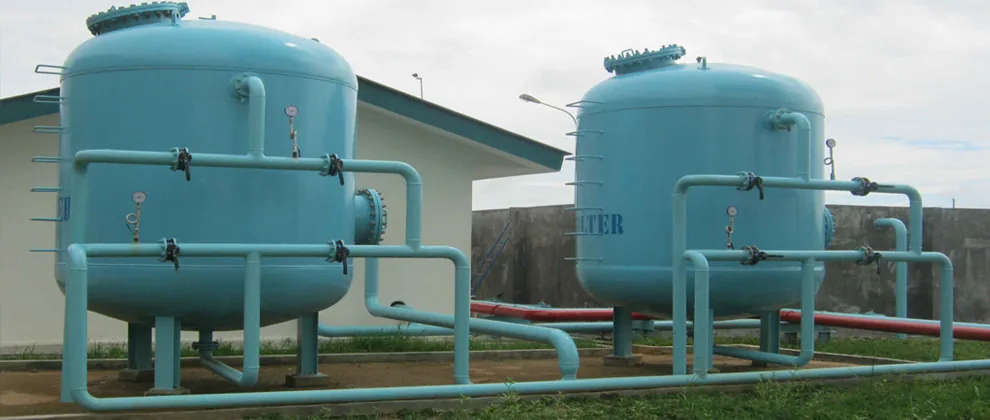
Pressure Sand Filter – PSF
Sand filters are used to remove suspended solids and turbidity from the service water. If the turbidity of the service water is greater than 1 NTU, a media filter is needed. The media filter is generally located at or near the upstream of the water treatment system, to protect downstream equipment from the suspended solids. Material of construction for Pressure vessel is MS, SS, and FRP.
Activated Carbon Filter – ACF
Activated Carbon Filtration is the process of removing free Chlorine Organic Matter, Suspended particles from water both course as well as colloidal, adsorbing undesired odor, colors etc. Activated carbon is a carbonaceous adsorbent with a high internal porosity, and hence a large internal surface area. Activated carbon is usually derived from charcoal or coconut shell. Material of construction for Filter vessel is MS, SS, and FRP.
Where Water Treatment Plants Are Used
- Borewell & groundwater treatment — removing turbidity, iron, and hardness for residential and commercial use
- Municipal & packaged drinking water — full treatment train from filtration to disinfection
- Industrial process water — pre-treatment ahead of RO, boilers, or cooling towers
- Housing societies & institutions — centralized raw water treatment for daily supply
Why Choose Optima Water Solutions for Water Treatment
Optima Water Solutions is an ISO 9001:2015 certified manufacturer with 12+ years of experience and 158+ completed projects across India. We design the full treatment train — media filtration, softening, demineralization, and membrane filtration — matched to your actual source water quality, so you aren't paying for treatment stages you don't need or missing ones you do.
Get a Quote for Water Treatment Plant
Free site visit & custom proposal from our engineers within 48 hours. ISO 9001:2015 certified. 158+ projects delivered across India.
Common Questions
Water Treatment Plant — Frequently Asked Questions
What is a Water Treatment Plant?
A Water Treatment Plant (WTP) removes suspended impurities, metals, ionic impurities, bacteria, and viruses from ground or surface water to make it safe for industrial, commercial, or residential use. It uses media filtration, microfiltration, ultrafiltration, softening, demineralization, and reverse osmosis depending on the application.
What is the difference between PSF and ACF?
A Pressure Sand Filter (PSF) removes suspended solids and turbidity from water. An Activated Carbon Filter (ACF) removes free chlorine, organic matter, odor, and color. Both are commonly used together as pre-treatment stages in water treatment systems.
When should I use a Water Softener vs a DM Plant?
A Water Softener removes hardness (calcium and magnesium ions) through cation exchange and is ideal for boiler feed water and cooling systems. A Demineralization (DM) Plant removes all ionic impurities and is required for applications needing very high-purity water such as pharmaceutical or electronics manufacturing.
How much does a Water Treatment Plant cost in Delhi NCR?
Costs range from ₹1 Lakh for small commercial units to ₹5 Crore or more for large industrial WTPs. The price depends on capacity, feed water quality, required output quality, and technology selection.
What is the maintenance requirement for a WTP?
Regular maintenance includes media backwashing (PSF/ACF — every 24–48 hours), resin regeneration (softener), membrane cleaning (UF/RO — monthly), UV lamp replacement (annually), and quarterly performance testing. Optima Water offers comprehensive AMC packages.
Can a WTP be automated?
Yes. Modern Water Treatment Plants by Optima Water feature PLC/SCADA automation with IoT-enabled remote monitoring, automatic backwash cycles, dosing pump controls, flow/pressure alarms, and data logging.
Ready to Start?
Free site visit and assessment by our engineers. 158+ projects delivered across India.