Water Solution – One Call Ahead
Enquire? Send Your Mail
How an RO Plant Is Built: The Stages
- Pre-treatment — sediment filtration, activated carbon (dechlorination), and antiscalant dosing to protect the RO membranes from fouling and scaling before water ever reaches them.
- High-pressure pumping — a pump raises feed water pressure above the osmotic pressure of the dissolved solids present, typically 8-25 bar for brackish water RO.
- Membrane separation — water is forced through spiral-wound RO membrane elements, which reject 95-99%+ of dissolved salts while permeate (purified water) passes through.
- Post-treatment — pH correction, remineralization (for drinking water), and UV or chlorine disinfection as a final polishing step.
Key Factors That Determine RO Plant Performance
| Factor | Why It Matters |
|---|---|
| Feed water TDS | Higher TDS requires higher operating pressure and affects membrane selection |
| Silt Density Index (SDI) | Predicts fouling rate — high SDI feed water needs more robust pre-treatment |
| Recovery rate target | Higher recovery reduces reject water but increases scaling risk — needs correct antiscalant dosing |
| Feed water temperature | Colder water reduces membrane permeability, affecting required membrane area |
This is exactly why we ask for a water quality report before quoting an RO plant rather than sizing purely off a requested flow rate — two sites both needing "5,000 LPH" can require meaningfully different membrane counts, pump ratings, and pre-treatment depending on their actual source water characteristics.
Reverse Osmosis Plant -RO Plant
We are a leading RO Plant Manufacturer in India. Reverse osmosis (RO) is a separation process that uses pressure to force a solution through a membrane that retains the solute on one side and allows the pure solvent to pass to the other side. More formally, it is the process of forcing a solvent from a region of high solute concentration through a membrane to a region of low solute concentration by applying a pressure in excess of the osmotic pressure. This is the reverse of the normal osmosis process, which is the natural movement of solvent from an area of low solute concentration, through a membrane, to an area of high solute concentration when no external pressure is applied.
This process is best known for its use in desalination (removing the salt from brackish & sea water to get fresh water), but it has also been used to purify fresh water for medical, industrial and domestic applications.
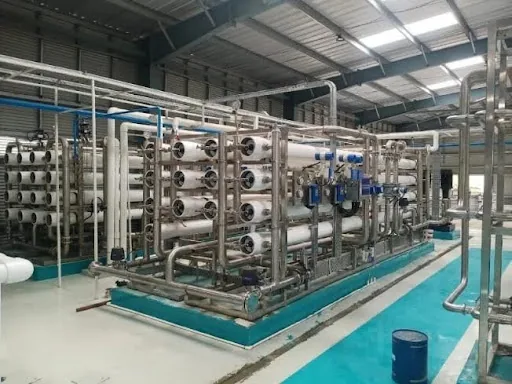
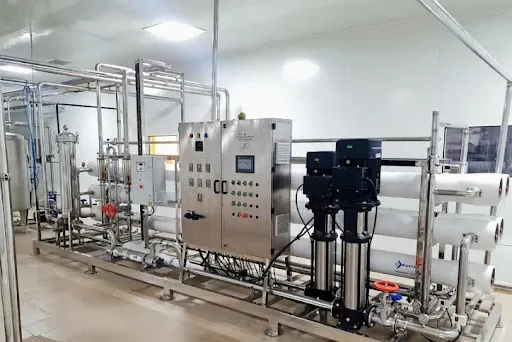
We offer both customized and standardized Skid mounted RO Plant, Containerized RO Plant for Export and Mobilization Purpose with Following Features.
- Smart Automation: Fully automatic systems with IoT-enabled remote monitoring for real-time performance tracking.
- Maximized Water Recovery: Advanced membranes achieving up to 70-75% recovery rates, significantly reducing wastewater.
- Durability & Hygiene: Built with high-grade Stainless Steel (SS) or corrosion-resistant FRP for long-term industrial reliability.
Energy Efficiency: Integration of Energy Recovery Devices (ERDs) and high-efficiency pumps to lower your electricity bill.
Where RO Plants Are Used
- Drinking water & packaged water plants — municipal-quality and bottled water production
- Industrial process water — boiler feed, pharmaceutical, and electronics manufacturing
- Residential & commercial buildings — centralized RO for apartments, offices, and hotels
- Export & remote projects — containerized/skid-mounted RO for quick mobilization to new sites
Why Choose Optima Water Solutions for RO Plants
Optima Water Solutions is an ISO 9001:2015 certified manufacturer with 12+ years of experience and 158+ completed projects across India. We design RO systems around your actual feed water quality (TDS, hardness, silt density index) rather than a generic capacity chart, which is what determines real-world recovery rate and membrane life. Support includes commissioning, membrane performance monitoring, and AMC contracts.
Get a Quote for RO Plant
Free site visit & custom proposal from our engineers within 48 hours. ISO 9001:2015 certified. 158+ projects delivered across India.
Common Questions
RO Plant — Frequently Asked Questions
What is a Reverse Osmosis (RO) Plant?
A Reverse Osmosis (RO) Plant is a water purification system that uses pressure to force water through a semi-permeable membrane, removing dissolved salts, heavy metals, bacteria, viruses, and other contaminants. It is the most effective technology for desalination and producing high-purity water for industrial, municipal, and commercial applications.
What is the cost of an industrial RO Plant in Delhi NCR?
Industrial RO Plant costs in Delhi NCR range from ₹2 Lakh for small systems (100–500 LPH) to ₹3 Crore or more for large high-recovery plants (1 MLD+). Costs depend on capacity, feed water TDS, required permeate quality, number of stages, and automation level.
What water recovery rate can be achieved by an RO Plant?
Modern RO plants with Energy Recovery Devices (ERDs) achieve 70–75% water recovery for brackish water. Higher recovery reduces wastewater discharge and lowers operating costs significantly.
What is the difference between a skid-mounted and containerized RO Plant?
A skid-mounted RO Plant is assembled on a steel frame and installed permanently at a site. A containerized RO Plant is built inside a standard shipping container, making it portable and ideal for remote locations or temporary deployments.
How often do RO membranes need to be replaced?
With proper pre-treatment and regular CIP chemical cleaning, industrial RO membranes typically last 3–5 years. Membrane life depends on feed water quality, operating pressure, recovery rate, and maintenance schedule.
What pre-treatment is required before an RO Plant?
Standard pre-treatment includes a Pressure Sand Filter (to remove suspended solids), an Activated Carbon Filter (to remove chlorine and organics), an Antiscalant dosing system (to prevent membrane scaling), and a 5-micron cartridge filter as a final guard.
Ready to Start?
Free site visit and assessment by our engineers. 158+ projects delivered across India.