Water Solution – One Call Ahead
Enquire? Send Your Mail

Optima Water Solutions is an STP Plant Manufacturer in Bengaluru. We design, install, commission, and maintain Sewage Treatment Plant systems, and hold ISO 9001:2015 certification with 12+ years of experience and 158+ completed projects across India. Our STP systems meet CPCB compliance standards and serve residential societies, commercial complexes, and industrial facilities in Bengaluru.
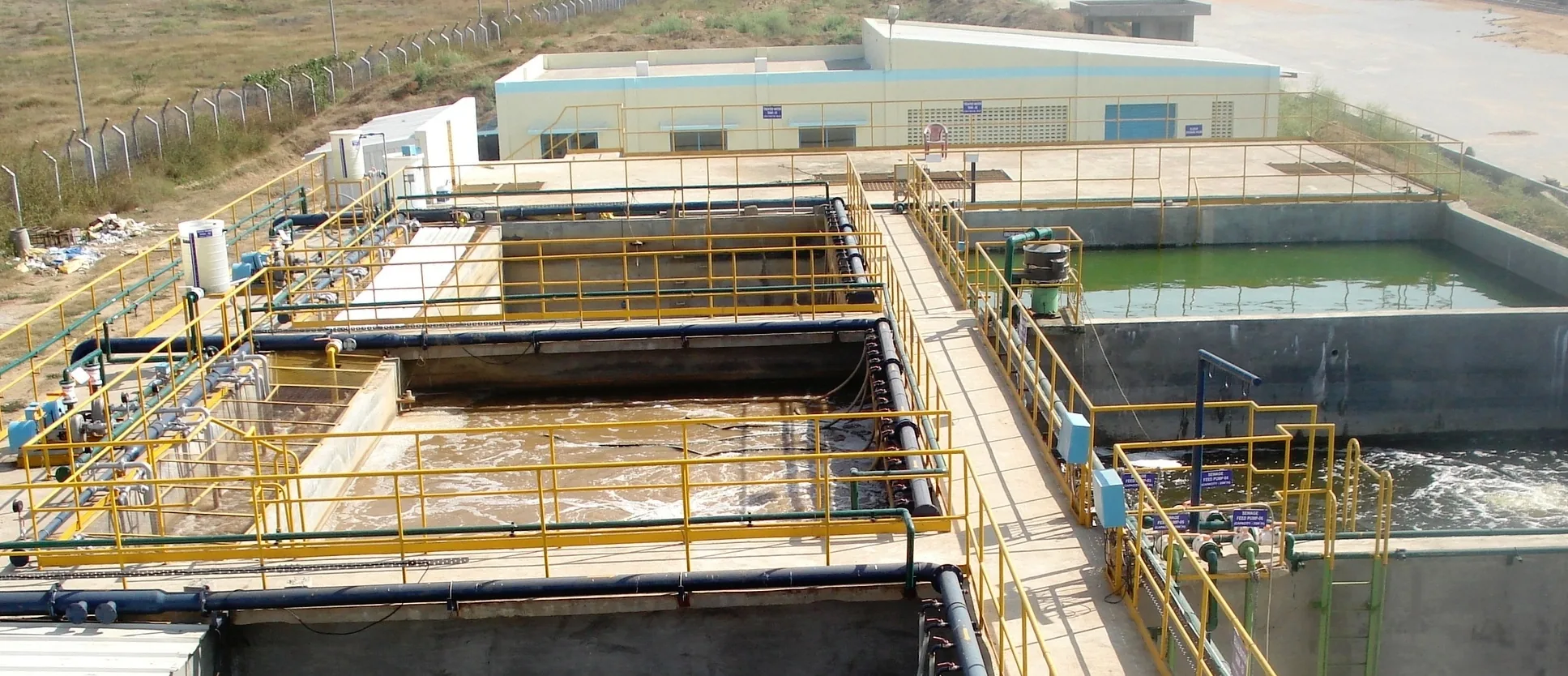
What is a Sewage Treatment Plant?
A Sewage Treatment Plant (STP) is a facility that processes domestic and municipal wastewater to remove contaminants before the treated water is discharged or reused. The process involves physical, biological, and chemical treatment stages that remove suspended solids, organic matter, nutrients, and pathogens.
Modern STP systems use technologies including MBBR (Moving Bed Biofilm Reactor), MBR (Membrane Bioreactor), SBR (Sequencing Batch Reactor), and conventional activated sludge processes — each suited to different capacities and site conditions.
In India, STPs are mandatory for residential societies above 20,000 sqm built-up area, commercial complexes, hotels, hospitals, and all industrial facilities discharging domestic effluent — as per CPCB norms and local Pollution Control Board regulations.
Sewage Treatment Plant in Bengaluru — Why It Matters
Bengaluru's STP market is shaped by two things most cities do not deal with at the same scale: a large stock of gated-community apartments built specifically around IT campuses, and a genuine water-stress problem that makes treated wastewater reuse a financial decision, not just a compliance one. BWSSB tanker water costs have pushed many Whitefield and Electronic City societies to size their STP for maximum flushing and landscaping reuse rather than the compliance minimum.
KSPCB inspection has also become noticeably stricter around Peenya and Bommasandra over the last few years, and a number of our Bengaluru enquiries now come from older societies whose plants were built to a lower standard than current KSPCB norms require and are being asked to upgrade.
Tech park campuses around Whitefield and Electronic City add a third category — commercial STPs sized for a daytime-only occupancy pattern that looks nothing like a residential flow curve, which changes how the plant should be sized and staffed.
Bengaluru Wastewater Challenges & How Optima Solves Them
Bengaluru's wastewater system is under strain from sheer growth. Lakes such as Bellandur and Varthur have been the focus of long-running pollution concern, groundwater has dropped in many neighbourhoods, and tanker water is a large and rising cost for apartments. Karnataka's rules respond by requiring apartment buildings to treat their own sewage, and the pollution board has acknowledged that enforcing reuse of the treated water is difficult in practice.
The practical problems are specific. A KSPCB official has said that even large complexes with parks and lawns reuse only about 40 to 50% of their treated water in-house, so many societies end up with surplus water and no outlet. Retrofit is hard: older apartments built with a single plumbing network have no dual lines for flushing. KSPCB guidelines also discourage placing a plant in the basement of residential towers because of odour, noise and vibration, so plants must go under driveways or in separate structures away from flats.
How Optima solves it: we design the plant for the whole water balance, not just treatment. That means sizing flushing, landscaping and cooling use up front, planning dual plumbing for new buildings and practical retrofit routes for old ones, locating blowers away from flats, and advising on how surplus treated water can be used or sold under the state's recent rules.
Key industrial areas we serve in Bengaluru:
Regulatory Note: Karnataka State Pollution Control Board (KSPCB) mandates STPs for large residential projects and ETPs for all category industries in Bengaluru.
STP Norms & Compliance in Bengaluru
The Karnataka State Pollution Control Board (KSPCB) requires Consent to Establish before construction and Consent to Operate after commissioning. Its rules require an STP for apartment buildings with more than 20 units or built-up area of 2,000 sq m or above, and its guidelines also cover educational institutions and large development projects. Separately, the Bangalore Water Supply and Sewerage Board (BWSSB) amended its sewerage regulations in March 2016 so that new and existing apartment buildings above 20 units connected to its network must install STPs.
KSPCB's STP guidelines add design rules: a dual plumbing arrangement for toilet flushing with treated water, blowers kept away from residential units, the plant preferably under a driveway, and no placement in the basement of apartment towers. Reported reuse-grade standards for Bengaluru are strict, around BOD 10 mg/L and TSS 10 mg/L, though the board has changed treated-water norms and fees over time, so check the current consent. The state has also moved to allow the sale of surplus treated water, which gives apartments an outlet.
Projects above 20,000 sq m also need environmental clearance, and hospitals face additional biomedical-waste obligations. We design to the figures in your consent.
STP Capacity & Technology for Bengaluru
Bengaluru is one of the few cities where we recommend treated water reuse as a cost argument first and a compliance argument second. With BWSSB tanker rates what they are, an MBR-based STP that produces reuse-grade water for flushing and landscaping typically pays back its higher upfront cost within a few years for a mid-size Whitefield or Electronic City society, purely on the reduction in tanker dependence.
Tech park and commercial campus STPs need a different sizing approach entirely. Occupancy peaks sharply on weekdays between roughly 9 am and 7 pm and drops close to zero on weekends, so a plant sized like a residential system either runs underloaded most of the time or struggles during the workday peak. We size these systems around the actual daily occupancy curve provided by the facility team rather than a flat per-person estimate, which is standard practice for residential design but not accurate for a campus.
Sizing examples. A 24-unit apartment building, just above the 20-unit threshold, houses about 108 residents at 135 litres, uses roughly 15 KLD and returns about 12 KLD, so a compact 15 KLD plant is enough. A 400-flat gated community with about 1,800 residents uses roughly 243 KLD and returns around 194 KLD, which points to a 200 KLD plant. A tech park with 8,000 staff at 45 litres uses about 360 KLD and returns roughly 288 KLD, with strong weekday peaks.
Which technology where. For small 20 to 100-unit buildings, a compact MBBR package fits narrow plots. MBR suits tech parks, hospitals and premium communities that want treated water for flushing and cooling towers, but remember surplus output must have a use. SBR fits large campuses and townships in Whitefield, Sarjapur Road and Electronic City with variable load. Units in Peenya, Bommasandra and Doddaballapur need an ETP for process wastewater; only staff and canteen sewage goes to the STP.
Our 4-Step Process — From Design to Handover
1
Site Assessment & Design
Free site visit. Wastewater characterisation. Custom system design based on flow rate, BOD, COD, and discharge norms.
2
Manufacturing & Supply
In-house fabrication at our Delhi NCR facility. All components tested before dispatch. Delivery to your site across India.
3
Installation & Commissioning
Expert installation team. Civil work coordination. Full commissioning with performance testing to CPCB standards.
4
O&M / AMC Support
Operator training. Annual Maintenance Contracts available. 24/7 emergency support. Guaranteed uptime.
Why Choose Optima Water Solutions
- ISO 9001:2015 certified manufacturer — quality assured at every stage
- 12+ years of experience — 158+ STP installations across India
- CPCB-compliant systems — all designs meet national discharge standards
- Full turnkey delivery — design, supply, install, commission, maintain
- In-house manufacturing — no middlemen, better quality control, faster delivery
- Post-installation AMC support — ongoing operations and maintenance contracts
- Multiple technology options — MBBR, MBR, SBR, conventional — best fit for your site
- Competitive pricing — transparent quotations, no hidden costs
- Pan India installation — projects completed from Delhi to Chennai to Mumbai
- Free site visit and technical assessment before any commitment
Industries & Applications in Bengaluru
Residential Societies
Hotels & Resorts
Hospitals
Commercial Complexes
Industrial Plants
Construction Sites
Educational Institutions
Government Projects
Need a Sewage Treatment Plant in Bengaluru?
Tell us your capacity, application and site requirements and our team can prepare a project-specific proposal. ISO 9001:2015 certified. 158+ projects delivered across India.
Related Services in Bengaluru
Learn More About Sewage Treatment Plant
Common Questions
Sewage Treatment Plant in Bengaluru — FAQ
Does an STP in Bengaluru make financial sense beyond compliance?
For most Whitefield and Electronic City societies, yes. With BWSSB tanker costs continuing to rise, an MBR-based STP that produces reuse-grade water for flushing and gardens typically offsets its higher upfront cost within a few years through reduced tanker dependence, on top of meeting KSPCB compliance.
Why is my older Bengaluru society being asked to upgrade its STP?
KSPCB has tightened inspection standards in recent years, particularly around the Peenya and Bommasandra belts, and plants built a decade or more ago to older norms often no longer meet current discharge limits. We assess existing plants and quote upgrade options rather than requiring a full rebuild wherever the existing tankage can be reused.
How is an STP for a Bengaluru tech park different from a residential one?
Tech park occupancy peaks sharply on weekdays and drops close to zero on weekends, unlike a residential flow curve that stays fairly steady. We size these commercial STPs around the campus's actual daily occupancy pattern rather than a flat per-person estimate, which avoids an underloaded or undersized plant.
What does an MBR-based STP cost in Bengaluru?
For a mid-size gated community of 500 to 1,000 flats, an MBR system built for flushing and landscaping reuse typically costs ₹28 Lakh to ₹90 Lakh, higher than a standard MBBR system but offset over time by lower BWSSB tanker dependence. Call +91 9711880791 for a reuse-focused quote.
Does Optima handle KSPCB compliance upgrades for existing Bengaluru plants?
Yes, this is one of our most common Bengaluru project types. We inspect the existing plant, identify the specific gap against current KSPCB norms, and quote whether a targeted upgrade or a phased rebuild is the better route for that site.
Does a 25-unit apartment building in Bengaluru need an STP?
Yes. KSPCB's rule applies from more than 20 units or 2,000 sq m of built-up area, and BWSSB's 2016 amendment applies the same threshold to buildings connected to its sewer network. A compact plant of around 15 KLD is typical at this size.
Where can an apartment STP be located in Bengaluru?
KSPCB's guidelines advise against basements of residential towers and ask for blowers to be kept away from flats, so plants usually go under driveways or in a separate enclosure with odour and noise control.
What happens to surplus treated water in a Bengaluru apartment?
Even large complexes reuse only part of it, so we plan flushing, landscaping and any cooling use up front and advise on the state's recent permission to sell surplus treated water.
Ready to Start?
Ask our team about site-assessment availability for your Bengaluru project.