Water Solution – One Call Ahead
Enquire? Send Your Mail

Optima Water Solutions is an STP Plant Manufacturer in Delhi. We design, install, commission, and maintain Sewage Treatment Plant systems, and hold ISO 9001:2015 certification with 12+ years of experience and 158+ completed projects across India. Our STP systems meet CPCB compliance standards and serve residential societies, commercial complexes, and industrial facilities in Delhi.
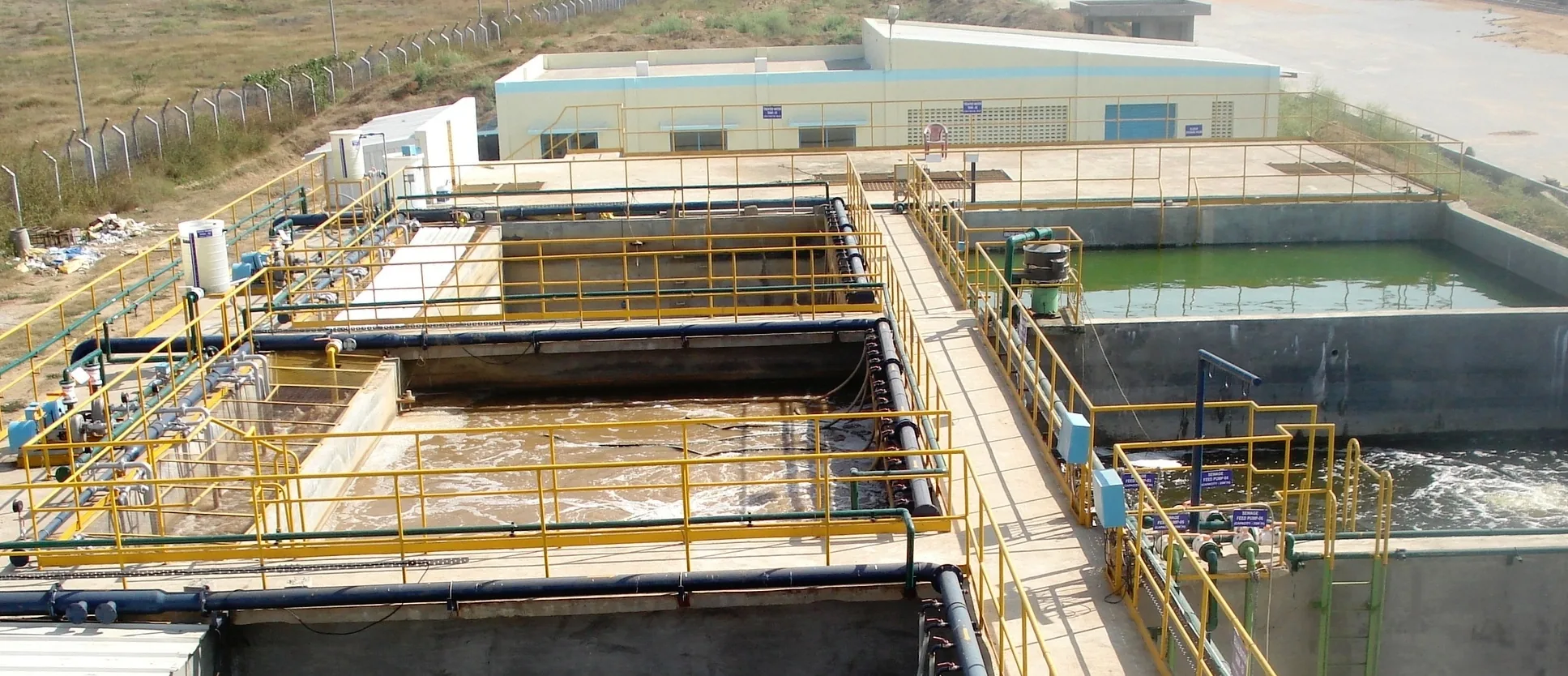
What is a Sewage Treatment Plant?
A Sewage Treatment Plant (STP) is a facility that processes domestic and municipal wastewater to remove contaminants before the treated water is discharged or reused. The process involves physical, biological, and chemical treatment stages that remove suspended solids, organic matter, nutrients, and pathogens.
Modern STP systems use technologies including MBBR (Moving Bed Biofilm Reactor), MBR (Membrane Bioreactor), SBR (Sequencing Batch Reactor), and conventional activated sludge processes — each suited to different capacities and site conditions.
In India, STPs are mandatory for residential societies above 20,000 sqm built-up area, commercial complexes, hotels, hospitals, and all industrial facilities discharging domestic effluent — as per CPCB norms and local Pollution Control Board regulations.
Sewage Treatment Plant in Delhi — Why It Matters
As Delhi continues to expand, demand for dependable STP capacity has grown alongside it, particularly around the city's established industrial belts. This is especially true around Okhla Industrial Area, Wazirpur Industrial Area, Lawrence Road Industrial Area, where DPCC inspection has become more consistent in recent years.
Optima Water Solutions delivers STP projects in Delhi end to end — design, manufacturing, installation, commissioning, and Annual Maintenance Contracts — so clients are not left coordinating multiple vendors for one system.
Delhi Wastewater Challenges & How Optima Solves Them
Delhi's wastewater problem is one of scale and space. The city produces far more sewage than its municipal network has historically treated, and the National Green Tribunal's Yamuna proceedings have shifted attention from how much is treated to how clean the treated water really is. Tribunal filings and audits have repeatedly flagged faecal coliform and suspended solids at municipal plants, so regulators now look much harder at any private STP that discharges or reuses water.
For a developer or facility manager the practical problems are more specific. Plots are tight, so the plant usually goes into a basement with limited ventilation and no room for large settling tanks. Groundwater is being extracted faster than it recharges, which pushes owners towards reuse and makes tanker bills hard to justify. And Delhi's mixed-use buildings — flats above shops, nursing homes inside residential colonies, hotels in dense markets — create kitchen grease, laundry and clinical load that a plain residential design never anticipated.
How Optima solves it: we design Delhi plants around the footprint first. That means compact MBBR or MBR trains, fine screening and grease removal ahead of the biology, and a disinfection stage (UV or chlorination, chosen by the reuse application) so that faecal coliform is controlled by design rather than assumed. Treated water goes back to flushing, horticulture and, where the building has chillers, cooling-tower make-up after extra polishing. AMC visits can include scheduled sampling of BOD, TSS and residual chlorine so your consent file stays current.
Key industrial areas we serve in Delhi:
Regulatory Note: Delhi Pollution Control Committee (DPCC) enforces strict wastewater norms under Environment Protection Act. STPs mandatory for group housing societies above 20,000 sqm and all commercial establishments above prescribed threshold.
STP Norms & Compliance in Delhi
Three layers apply to an STP in Delhi. The Delhi Pollution Control Committee (DPCC) grants Consent to Establish and Consent to Operate under the Water Act, and the operating consent is needed before the plant runs and the building is occupied. Building sanction through DDA, MCD or NDMC requires the water, sewerage and drainage schemes to be cleared with the Delhi Jal Board, which is where STP provision is checked at design stage. Projects above 20,000 sq m of built-up area also need environmental clearance, and that approval writes STP, reuse and monitoring conditions into the project.
On quality, the NGT order of 30 April 2019 set a BOD ceiling of 10 mg/L for new STPs in large cities, with limits on suspended solids, nitrogen and faecal coliform alongside. In the Yamuna matter the Tribunal went further for municipal plants, directing Delhi Jal Board STPs to be upgraded to 10/10 mg/L BOD/TSS. Published summaries quote some of these figures differently, and boards apply them through each project's own consent letter, so we design to the numbers written into yours rather than to a generic table.
Reuse is the direction of travel. The Delhi Jal Board has approved a reclaimed-water policy, reported in 2026, that aims to move construction and horticulture demand onto treated water. Confirm the notification status for your project, but design for reuse from day one, because that is where an on-site plant earns its money back.
Organisations We Have Worked With in Delhi
A selection of clients we have supported on water and wastewater projects across Delhi. We can share a reference list for your sector on request.
Indian Council of Social Science Research (ICSSR)
New Delhi
Unique Infra Pvt. Ltd.
New Delhi
Shanvi Estate Management Services Pvt. Ltd.
New Delhi
Dutt Mediproducts Pvt. Ltd.
New Delhi
Startech Project Design Build
New Delhi
True Villas Developers Pvt. Ltd.
New Delhi
STP Solutions Across Delhi
Optima serves Delhi through dedicated pages for each city we actively work in — each with its own local details on regulations, industrial zones, and pricing. Pick your city below.
STP Capacity & Technology for Delhi
Sizing by building type. Sewage is normally taken as about 80% of the water supplied. A 300-flat society with roughly 1,350 residents at 135 litres per head per day uses about 182 KLD and returns around 146 KLD of sewage, so a 175 KLD plant leaves sensible headroom. A 120-room hotel (about 240 beds at 180 litres per bed) draws near 43 KLD before banquet and laundry load, which is why we usually quote around 60 KLD with a grease trap and an equalisation tank. A 100-bed nursing home at 340 litres per bed uses about 34 KLD and needs a stricter disinfection stage than a residential plant.
MBBR, MBR or SBR for Delhi sites? MBBR is the default for most residential and commercial projects: compact, tolerant of load swings and simple to operate. MBR suits basement plants, tight plots and premium buildings where treated water feeds flushing or cooling towers, because the membranes give very low suspended solids and a firmer pathogen barrier in the smallest footprint, at the price of higher energy use and periodic membrane replacement. SBR works well for schools, government campuses and offices with strong day-night swings, since batch cycles absorb variable flow and can be tuned for nitrogen removal, but it depends on reliable automation. Small units in Okhla, Wazirpur or Naraina rarely need more than a domestic STP for staff and canteen; where a unit is connected to a common effluent treatment plant, process wastewater is handled separately from the STP.
Our 4-Step Process — From Design to Handover
1
Site Assessment & Design
Free site visit. Wastewater characterisation. Custom system design based on flow rate, BOD, COD, and discharge norms.
2
Manufacturing & Supply
In-house fabrication at our Delhi NCR facility. All components tested before dispatch. Delivery to your site across India.
3
Installation & Commissioning
Expert installation team. Civil work coordination. Full commissioning with performance testing to CPCB standards.
4
O&M / AMC Support
Operator training. Annual Maintenance Contracts available. 24/7 emergency support. Guaranteed uptime.
Why Choose Optima Water Solutions
- ISO 9001:2015 certified manufacturer — quality assured at every stage
- 12+ years of experience — 158+ STP installations across India
- CPCB-compliant systems — all designs meet national discharge standards
- Full turnkey delivery — design, supply, install, commission, maintain
- In-house manufacturing — no middlemen, better quality control, faster delivery
- Post-installation AMC support — ongoing operations and maintenance contracts
- Multiple technology options — MBBR, MBR, SBR, conventional — best fit for your site
- Competitive pricing — transparent quotations, no hidden costs
- Pan India installation — projects completed from Delhi to Chennai to Mumbai
- Free site visit and technical assessment before any commitment
Industries & Applications in Delhi
Residential Societies
Hotels & Resorts
Hospitals
Commercial Complexes
Industrial Plants
Construction Sites
Educational Institutions
Government Projects
Need a Sewage Treatment Plant in Delhi?
Tell us your capacity, application and site requirements and our team can prepare a project-specific proposal. ISO 9001:2015 certified. 158+ projects delivered across India.
Related Services in Delhi
Learn More About Sewage Treatment Plant
Common Questions
Sewage Treatment Plant in Delhi — FAQ
What determines STP pricing for a Delhi project?
Capacity, technology, and site conditions are the main cost drivers for an STP in Delhi. Smaller systems start from roughly ₹4-6 Lakh, with cost scaling for higher flow rates or added treatment stages. We quote after seeing the site.
Is STP compliance mandatory for Delhi developments?
For most projects above the applicable size threshold, yes. The Delhi Pollution Control Board and CPCB both apply requirements to residential, commercial, and industrial sites in Delhi. We help confirm which rules apply to your specific development.
Which treatment technology fits Delhi projects best?
MBBR is the standard, cost-effective choice for most Delhi projects. For sites that need treated water for reuse — flushing, gardens, or similar — MBR technology is usually the better fit despite the higher upfront cost.
How soon can an STP be operational in Delhi?
From order confirmation, a packaged STP in Delhi typically reaches commissioning within 4 to 8 weeks, assuming the site is ready for installation. We manage the schedule directly with your civil and project teams.
What ongoing support does Optima offer in Delhi?
We provide Annual Maintenance Contracts for Delhi clients, covering scheduled servicing, breakdown response, and operator training, so the STP continues to perform reliably well after the initial installation.
Does a Delhi STP need a faecal coliform control stage?
Yes. Faecal coliform is the parameter regulators have most often found missing at Delhi plants, so we build disinfection into the design, using UV or chlorination depending on whether the water goes to flushing, gardening or cooling-tower make-up, and we test it on every AMC visit.
Can treated water from my Delhi STP be used in a cooling tower?
Usually yes, but not straight from the biological stage. Cooling towers need lower suspended solids and controlled hardness, so we add filtration (and softening or ultrafiltration where required) before the water reaches the chillers.
When does a Delhi project need MBR instead of MBBR?
Choose MBR when the plant must fit a basement or a very small footprint, or when the treated water has a demanding reuse target. For a standard group-housing society with space for tanks, MBBR with tertiary filtration is normally the more economical choice.
Ready to Start?
Ask our team about site-assessment availability for your Delhi project.