Water Solution – One Call Ahead
Enquire? Send Your Mail

Optima Water Solutions is an STP Plant Manufacturer in Ghaziabad. We design, install, commission, and maintain Sewage Treatment Plant systems, and hold ISO 9001:2015 certification with 12+ years of experience and 158+ completed projects across India. Our STP systems meet CPCB compliance standards and serve residential societies, commercial complexes, and industrial facilities in Ghaziabad.
What is a Sewage Treatment Plant?
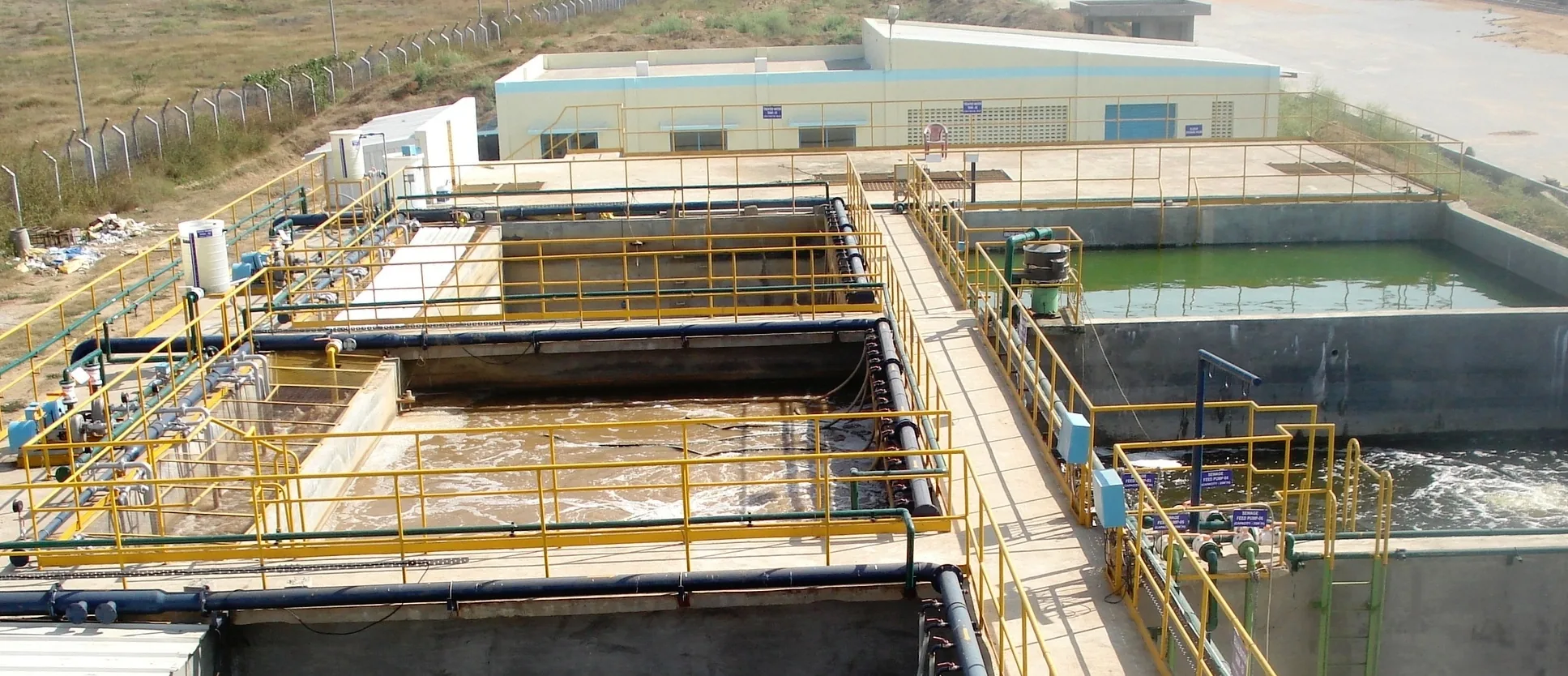
A Sewage Treatment Plant (STP) is a facility that processes domestic and municipal wastewater to remove contaminants before the treated water is discharged or reused. The process involves physical, biological, and chemical treatment stages that remove suspended solids, organic matter, nutrients, and pathogens.
Modern STP systems use technologies including MBBR (Moving Bed Biofilm Reactor), MBR (Membrane Bioreactor), SBR (Sequencing Batch Reactor), and conventional activated sludge processes — each suited to different capacities and site conditions.
In India, STPs are mandatory for residential societies above 20,000 sqm built-up area, commercial complexes, hotels, hospitals, and all industrial facilities discharging domestic effluent — as per CPCB norms and local Pollution Control Board regulations.
Sewage Treatment Plant in Ghaziabad — Why It Matters
Ghaziabad's industrial and residential growth has made STP infrastructure a practical necessity, not just a compliance checkbox. This is especially true around Loni Industrial Area, Sahibabad Industrial Area, Modinagar Industrial, where UPPCB inspection has become more consistent in recent years.
Optima Water Solutions delivers STP projects in Ghaziabad end to end — design, manufacturing, installation, commissioning, and Annual Maintenance Contracts — so clients are not left coordinating multiple vendors for one system.
Ghaziabad Wastewater Challenges & How Optima Solves Them
Ghaziabad sits between two stressed drainage systems. The Hindon river and the Kondli drain both carry heavy pollution loads, and the Tribunal's oversight reports on Ghaziabad record old municipal plants that run to older discharge limits and could not meet tighter norms if those were applied. Large new plants have been built, such as the Indirapuram facilities that use SBR, MBR and UASB processes, but the density of high-rise housing keeps growing faster than public capacity.
For private owners the problems are familiar ones. Societies in Indirapuram, Vaishali, Vasundhara and Raj Nagar Extension share tight plots with deep basements. Colleges and hospitals produce sharp daily peaks. Industrial clusters in Sahibabad, Loni and Hapur Road combine process wastewater with staff sewage. Next door in Noida, UPPCB's review of 95 listed group-housing societies found most of them defaulting on STP installation, operation or discharge norms, and environmental compensation followed, which is a clear signal of how enforcement now works on this side of the Delhi border.
How Optima solves it: we select technology by what the site can actually sustain. Compact MBBR or MBR for basement-constrained societies, SBR for campuses with large, uneven flows, and a separate ETP for factories. We design plants with sampling points and help assemble the documents your consent file needs, and we support Ghaziabad sites from our Faridabad head office.
Key industrial areas we serve in Ghaziabad:
Regulatory Note: UPPCB regulates industries in Ghaziabad. Mandatory ETP for all industrial units. STPs required for residential complexes and commercial developments under RERA norms.
STP Norms & Compliance in Ghaziabad
Uttar Pradesh has no single state STP law; instead the Uttar Pradesh Pollution Control Board (UPPCB) controls consent under the Water Act, and the Ghaziabad Development Authority (GDA) and Nagar Nigam decide through their byelaws and sanctions whether a given building must provide an STP. In practice, larger group-housing projects and most institutional, commercial and hospitality buildings are expected to treat their own sewage.
Consent to Establish is applied for before construction, and Consent to Operate before occupation. The Noida compliance record shows why that sequence matters: in a case before the Tribunal, a housing complex that ran without operating consent was assessed environmental compensation even though a sample of its treated water met the limits. Projects above 20,000 sq m of built-up area also require environmental clearance.
On quality, the Tribunal's April 2019 order set a BOD ceiling of 10 mg/L for new STPs in large cities, with limits on suspended solids and faecal coliform. UPPCB applies limits through each unit's consent, and some older municipal plants still operate to a 30 mg/L BOD standard, so check the number in your own letter and design with margin.
Organisations We Have Worked With in Nearby Noida and Greater Noida
A selection of clients we have supported on water and wastewater projects. We can share a reference list for your sector on request.
Windsor IT Park
Noida
Varindera Construction
Noida
Omaxe Ltd.
Noida
Rudrabhishek Enterprises Ltd. (REPL)
Noida
Mahindra Auto Industries Pvt. Ltd.
Noida
Aadhar Buildcon (India) Pvt. Ltd.
Noida
UEM India Pvt. Ltd.
Noida
Minda Corporation Pvt. Ltd.
Greater Noida
Toshiba India Pvt. Ltd.
Noida
Minda Corporation Pvt. Ltd.
Noida
Biranerwala Foods Pvt. Ltd. (Birano)
Greater Noida
STP Capacity & Technology for Ghaziabad
Sizing for Ghaziabad projects. A 300-flat society in Indirapuram or Vaishali with about 1,350 residents at 135 litres per head uses roughly 182 KLD and returns about 146 KLD; a 175 KLD plant is a sensible fit. An engineering or management campus with 5,000 day students and staff at 45 litres and 1,000 hostel residents at 135 litres uses about 360 KLD and returns roughly 288 KLD, which points to a 300 KLD plant. A 300-bed hospital at 450 litres per bed uses about 135 KLD and returns around 108 KLD.
MBBR, MBR or SBR? MBBR remains the standard answer for steady residential and commercial flow. MBR makes sense where the plant sits in a basement or treated water must meet a high reuse standard for flushing and landscaping. SBR is a strong fit for campuses and townships with variable flow, and its record in Ghaziabad is documented: the GDA's 56 MLD municipal plant is an SBR, and the Indirapuram plants use MBR and UASB. Factories in Sahibabad, Loni, Modinagar and Hapur Road need an ETP matched to their process; domestic staff sewage goes to a separate STP.
Our 4-Step Process — From Design to Handover
1
Site Assessment & Design
Free site visit. Wastewater characterisation. Custom system design based on flow rate, BOD, COD, and discharge norms.
2
Manufacturing & Supply
In-house fabrication at our Delhi NCR facility. All components tested before dispatch. Delivery to your site across India.
3
Installation & Commissioning
Expert installation team. Civil work coordination. Full commissioning with performance testing to CPCB standards.
4
O&M / AMC Support
Operator training. Annual Maintenance Contracts available. 24/7 emergency support. Guaranteed uptime.
Why Choose Optima Water Solutions
- ISO 9001:2015 certified manufacturer — quality assured at every stage
- 12+ years of experience — 158+ STP installations across India
- CPCB-compliant systems — all designs meet national discharge standards
- Full turnkey delivery — design, supply, install, commission, maintain
- In-house manufacturing — no middlemen, better quality control, faster delivery
- Post-installation AMC support — ongoing operations and maintenance contracts
- Multiple technology options — MBBR, MBR, SBR, conventional — best fit for your site
- Competitive pricing — transparent quotations, no hidden costs
- Pan India installation — projects completed from Delhi to Chennai to Mumbai
- Free site visit and technical assessment before any commitment
Industries & Applications in Ghaziabad
Residential Societies
Hotels & Resorts
Hospitals
Commercial Complexes
Industrial Plants
Construction Sites
Educational Institutions
Government Projects
Need a Sewage Treatment Plant in Ghaziabad?
Tell us your capacity, application and site requirements and our team can prepare a project-specific proposal. ISO 9001:2015 certified. 158+ projects delivered across India.
Related Services in Ghaziabad
Learn More About Sewage Treatment Plant
Common Questions
Sewage Treatment Plant in Ghaziabad — FAQ
What determines STP pricing for a Ghaziabad project?
Capacity, technology, and site conditions are the main cost drivers for an STP in Ghaziabad. Smaller systems start from roughly ₹4-6 Lakh, with cost scaling for higher flow rates or added treatment stages. We quote after seeing the site.
Is STP compliance mandatory for Ghaziabad developments?
For most projects above the applicable size threshold, yes. The Uttar Pradesh Pollution Control Board and CPCB both apply requirements to residential, commercial, and industrial sites in Ghaziabad. We help confirm which rules apply to your specific development.
Which treatment technology fits Ghaziabad projects best?
MBBR is the standard, cost-effective choice for most Ghaziabad projects. For sites that need treated water for reuse — flushing, gardens, or similar — MBR technology is usually the better fit despite the higher upfront cost.
How soon can an STP be operational in Ghaziabad?
From order confirmation, a packaged STP in Ghaziabad typically reaches commissioning within 4 to 8 weeks, assuming the site is ready for installation. We manage the schedule directly with your civil and project teams.
What ongoing support does Optima offer in Ghaziabad?
We provide Annual Maintenance Contracts for Ghaziabad clients, covering scheduled servicing, breakdown response, and operator training, so the STP continues to perform reliably well after the initial installation.
Do I need UPPCB consent before residents move into a Ghaziabad society?
Yes. Consent to Operate should be in place before occupation. Societies that operated without it have been assessed environmental compensation even where their treated water met the discharge limits.
Is SBR a proven technology for Ghaziabad?
Yes. The Ghaziabad Development Authority's 56 MLD municipal plant is an SBR, and campus and township plants of a few hundred KLD use the same batch principle. We recommend it where flow varies a lot through the day.
What is the right STP size for a Ghaziabad college or hospital?
Work from occupancy: about 45 litres per day student, 135 per hostel resident and 450 per hospital bed, then take sewage as roughly 80% of water use. A site visit confirms the real figures before we quote.
Ready to Start?
Ask our team about site-assessment availability for your Ghaziabad project.