Zero Liquid Discharge (ZLD) Plant in India — Complete Guide 2026
What is Zero Liquid Discharge (ZLD)?
Zero Liquid Discharge (ZLD) is an advanced industrial wastewater treatment strategy in which absolutely no liquid effluent is discharged from the plant boundary into drains, rivers, groundwater, or the environment. Instead, every litre of wastewater generated by the facility is treated, recovered as reusable water, and returned to the process — leaving behind only dry solid waste (salt cake or crystallised solids) that can be safely disposed of or sold.
ZLD is not a single technology — it is a system of multiple treatment stages working in sequence to progressively concentrate and ultimately eliminate liquid waste. In India, ZLD is increasingly mandated by CPCB and state PCBs for highly polluting industries operating near water-stressed regions, river basins, and coastal zones.
Why ZLD Has Become Critical in India in 2026
India's groundwater crisis, river pollution emergencies, and tightening NGT (National Green Tribunal) orders have made ZLD a regulatory necessity, not just a best practice. Key drivers in 2026 include:
- CPCB's 2015 and updated 2022 directions mandating ZLD for textile, distillery, pulp and paper, and tannery industries near critically polluted areas.
- NGT orders prohibiting discharge by pharma industries in Hyderabad's Patancheru-Bollaram corridor and Baddi-Barotiwala-Nalagarh belt in Himachal Pradesh.
- Gujarat GPCB enforcing ZLD for all dyeing and printing units in CETP zones as a condition of operating consent.
- State-level ZLD mandates in Maharashtra for sugar and distillery industries near river-sensitive zones.
- Export compliance: international buyers in garment and textile sectors requiring ZLD certification from Indian suppliers.
How Does a ZLD Plant Work? Stage-by-Stage Process
Stage 1: Primary and Secondary Effluent Treatment
Raw industrial effluent first goes through conventional ETP stages — primary clarification, biological treatment (MBBR or SBR), and secondary clarification. The objective here is to reduce BOD, COD, TSS, and colour to acceptable levels before membrane treatment. This is the same as a standard ETP — ZLD begins with a well-performing ETP as its foundation.
Stage 2: Tertiary Treatment — Multimedia and Activated Carbon Filtration
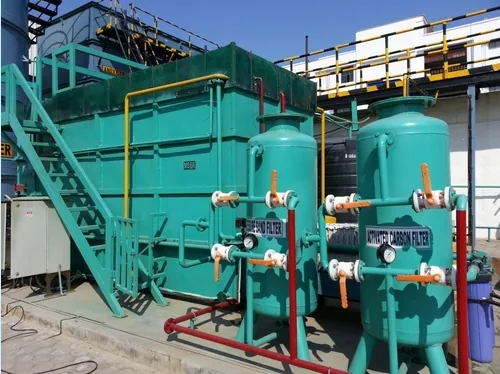
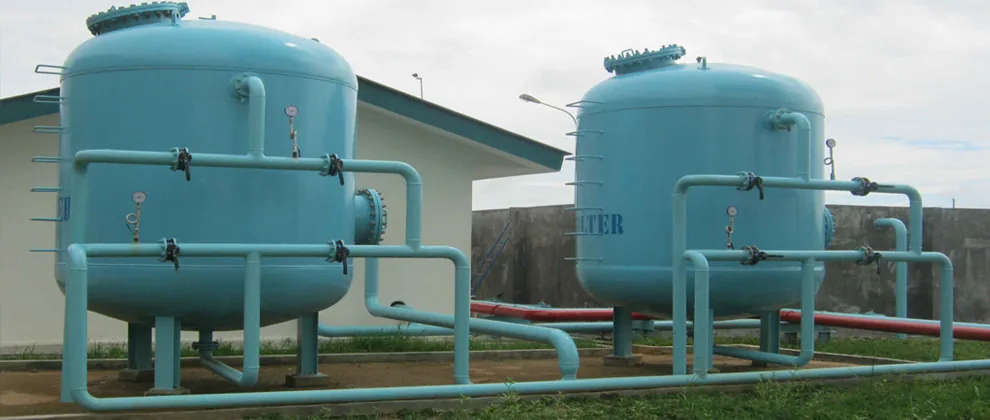
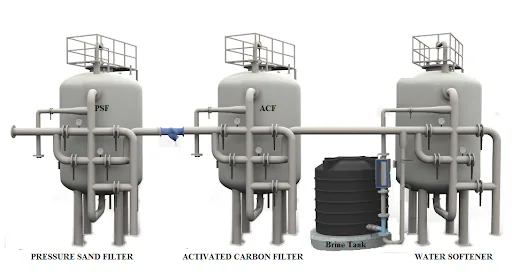
Secondary clarifier output is polished through multimedia filters (sand + anthracite) and activated carbon filters (ACF) to remove residual suspended solids, colour, and organics. This step protects downstream membranes from fouling and extends membrane life significantly.
Stage 3: Reverse Osmosis (RO) — Primary Concentration
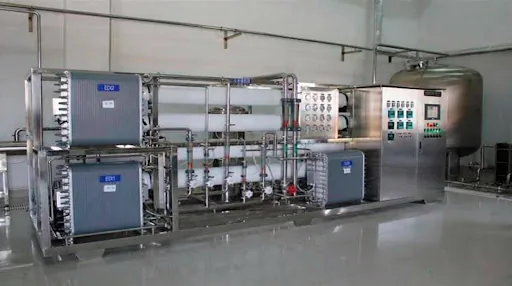
The most critical concentration step. Tertiary-treated effluent is pumped through high-pressure RO membranes (typically 15–40 bar for industrial applications). RO rejects 95–99% of dissolved salts, producing:
- Permeate (clean water): 60–75% of the feed volume, suitable for reuse in cooling towers, toilet flushing, boiler make-up, or process operations.
- Concentrate (reject): 25–40% of the feed volume, with 3–5× the salt concentration of the inlet. This concentrate goes to further treatment.
Stage 4: Concentration Using Evaporation Systems
RO concentrate contains very high dissolved solids (TDS 15,000–50,000+ mg/L) and cannot be processed by a second RO pass economically. Two evaporation technologies are used:
- MEE (Multiple Effect Evaporator): Uses steam to evaporate water from the concentrate across a series of vessels (effects) operating at decreasing pressure and temperature. Each effect reuses the latent heat of the previous one, making MEE 2–4× more energy efficient than single-stage evaporation. Typically recovers 85–90% of the water from the concentrate stream.
- MVR (Mechanical Vapour Recompression): Uses a mechanical compressor to recompress the vapour generated during evaporation and reuse it as the heating medium — eliminating the need for steam. MVR is highly energy efficient (operating cost ~50–60% lower than MEE) and is preferred for new ZLD installations above 100 KLD.
Stage 5: Crystallisation (Optional — for True ZLD)
Evaporator condensate is sent back for reuse. The thick slurry from the evaporator — containing 30–45% dissolved solids — is fed into a crystalliser, which further concentrates and solidifies the dissolved salts into a dry, handleable salt cake or crystalline solid. The crystalliser ensures literally zero liquid output. The dry salt is collected and disposed of as per CPCB Hazardous Waste Management Rules, or, in some cases (for sodium chloride from textile ETP), sold to chemical processors.
ZLD Plant Process Flow Summary
| Stage | Technology | Output | Recovery |
|---|---|---|---|
| Primary + Secondary ETP | Clarifier + MBBR/SBR | Treated effluent (BOD <30) | — |
| Tertiary | MMF + ACF + UF | Feed-ready for RO | ~98% |
| RO | High-pressure membranes | Permeate (reuse) + Concentrate | 65–75% water |
| MEE / MVR | Evaporation | Distillate (reuse) + Slurry | 85–90% water |
| Crystalliser | Forced circulation crystalliser | Dry salt cake | 100% liquid eliminated |
Which Industries Need ZLD in India?
As of 2026, CPCB and state PCBs have mandated or are actively pushing ZLD for the following industry categories:
- Textile and dyeing: Highly coloured effluent with high TDS. Tirupur (Tamil Nadu), Surat (Gujarat), Panipat (Haryana), and Ichalkaranji (Maharashtra) have large-scale ZLD CETPs.
- Distilleries: Spent wash (primary by-product) has extremely high BOD and COD. ZLD or biomethanation + evaporation is mandatory.
- Pharmaceutical: Baddi (HP), Patancheru (Telangana), Ankleshwar (Gujarat). NGT orders enforced with plant closure as penalty for non-compliance.
- Tanneries: High TDS, chromium, and sulphide content. Kanpur, Unnao, and Chennai tannery clusters under strict ZLD mandates.
- Pulp and paper: High COD and colour effluent. CPCB 2015 direction mandates ZLD for large mills.
- Chlor-alkali and fertiliser: High TDS and specific toxic ions mandate ZLD near coastal and river-sensitive zones.
ZLD Plant Cost in India 2026
ZLD is a significant capital investment, primarily because of the energy-intensive evaporation stage. Cost depends strongly on the effluent volume, TDS level, and RO recovery achievable.
| Capacity (KLD) | Approx. Capital Cost (₹ Crore) | Operating Cost (₹/KL treated) |
|---|---|---|
| 50 KLD | ₹2–4 crore | ₹350–₹600/KL |
| 100 KLD | ₹4–7 crore | ₹300–₹500/KL |
| 250 KLD | ₹8–14 crore | ₹250–₹400/KL |
| 500 KLD | ₹16–28 crore | ₹200–₹350/KL |
The evaporation stages (MEE/MVR) account for 50–65% of both capital and operating cost. MVR systems have higher capital cost but significantly lower operating cost over the 15–20 year plant life.
ZLD vs Conventional ETP — Key Differences
| Parameter | Conventional ETP | ZLD System |
|---|---|---|
| Liquid discharge | Yes (to drain/CETP) | None |
| Water recovery | 0% | 90–98% |
| Capital cost | Low–Medium | High |
| Operating cost | Low | High (energy-intensive) |
| Regulatory compliance | Conditional | Full ZLD mandate compliance |
| Solid waste output | Sludge cake | Salt cake + sludge |
Why Choose Optima Water Solutions for Your ZLD Plant?
Optima Water Solutions designs and implements complete ZLD systems — from the primary ETP stage through RO, MEE, and crystallisation — for pharmaceutical, textile, and chemical industries across India. Our engineering team conducts detailed treatability studies and process simulations before finalising the ZLD design, ensuring maximum water recovery at the lowest life-cycle cost.
Contact us at +91 9711880791 or visit our Effluent Treatment Plant page for a detailed ZLD feasibility assessment. You may also find our Sewage Treatment Plant and Nano Filtration Plant pages useful for your facility.