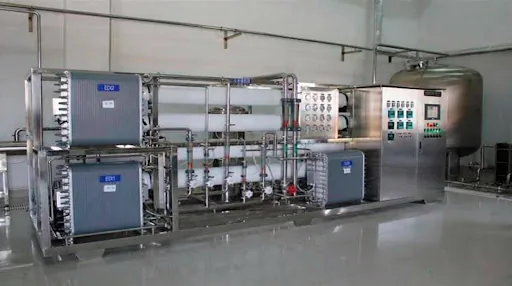
EDI vs Mixed Bed DM Plant: Which Should You Choose?
Two Paths to Ultrapure Water
Both EDI (Electrodeionization) and Mixed Bed Deionization (DM) produce high-resistivity, ultrapure water for pharmaceutical, power, and electronics applications — but they get there through fundamentally different mechanisms, with real operational consequences for whoever runs the plant day to day.
How Mixed Bed DM Works
A mixed bed DM plant combines cation and anion exchange resin in a single vessel. As water passes through, the resin removes dissolved ions until it becomes exhausted — at which point it must be regenerated using acid (typically HCl) and caustic (NaOH) chemicals, a batch process that takes the plant offline and requires safe handling, storage, and neutralization of hazardous regeneration chemicals.
How EDI Works
EDI combines ion-exchange resin with ion-selective membranes and a continuous electrical field. Rather than being regenerated in batches with chemicals, the resin is continuously regenerated electrically as water flows through — meaning no downtime for regeneration and no hazardous chemical handling at all.
Side-by-Side Comparison
- Chemical handling: Mixed bed requires on-site acid/caustic storage and handling; EDI requires none.
- Downtime: Mixed bed goes offline during regeneration; EDI runs continuously.
- Output consistency: Mixed bed resistivity drifts downward as resin exhausts between regenerations; EDI maintains stable output throughout.
- Waste stream: Mixed bed produces periodic hazardous chemical waste needing neutralization; EDI produces a small continuous reject stream with no chemical neutralization needed.
- Capital cost: Mixed bed is often lower upfront; EDI typically costs more initially but saves on chemical handling infrastructure and operational labor over time.
Which One Should You Choose?
For new installations, EDI has become the default choice across pharmaceutical, power, and electronics industries specifically because eliminating on-site hazardous chemical handling simplifies safety compliance and reduces operational risk — often justifying the higher upfront cost on its own. Mixed bed DM still makes sense where capital budget is the primary constraint and a facility already has established safe chemical handling infrastructure and trained personnel. Both require RO pretreatment to perform correctly; neither is a standalone technology.